Cette page est une traduction générée par IA du guide en anglais. Si vous êtes locuteur natif de français, aidez-nous à améliorer cette traduction en nous contactant.
Le protocole de prévention
Instructions étape par étape pour utiliser des doses faibles et espacées de psilocybine, LSD, LSA ou 5-MeO-DALT afin de prévenir les AVF.

Rédigé par Peter Skov-Andersen, MSc
Cette page présente le protocole concret que les patients utilisent depuis près de 30 ans pour prévenir ou interrompre un cycle d'AVF à l'aide de doses faibles et espacées d'une substance de la classe des tryptamines. Le protocole est le même pour la psilocybine, le LSD, le LSA et le 5-MeO-DALT. Seuls les doses et le calendrier des prises diffèrent légèrement. Nous résumons ces différences dans un tableau de référence rapide à la fin.
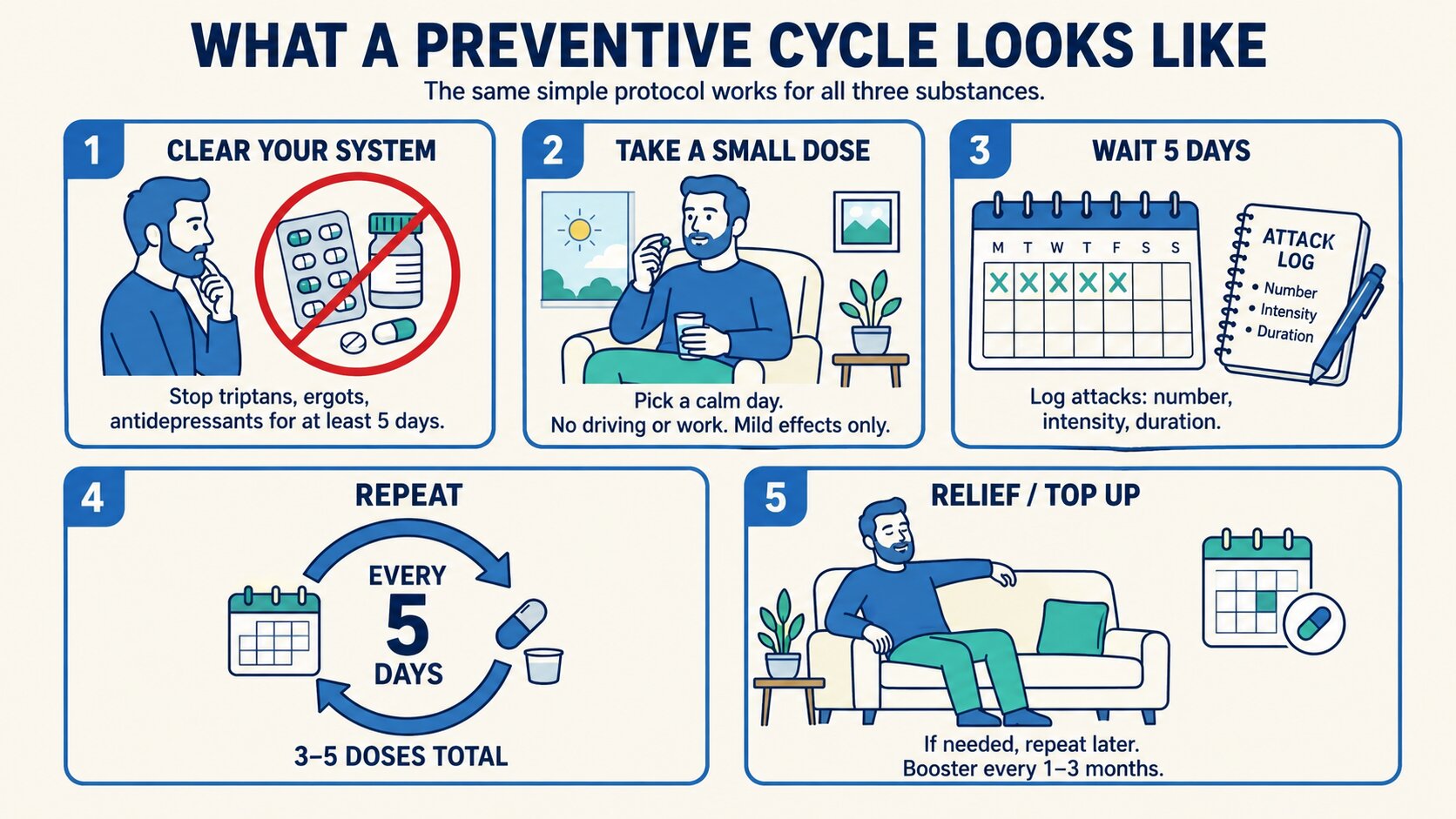
Avant de commencer
Deux choses à régler avant votre première dose : éliminer de votre organisme les médicaments susceptibles d'interférer (lire le chapitre sur la sécurité), et choisir une journée calme et un cadre confortable.
Éliminer les médicaments interférents
Un certain nombre de médicaments couramment utilisés contre l'AVF peuvent atténuer ou bloquer complètement l'effet du protocole. La principale raison d'échec du traitement est l'interférence avec d'autres médicaments. La règle prudente est d'attendre cinq jours après votre dernière prise de l'un des médicaments suivants avant de prendre votre première dose préventive :[1]
- Triptans (sumatriptan, zolmitriptan, rizatriptan, naratriptan, frovatriptan, almotriptan, élétriptan).
- Ergotamines (dihydroergotamine, méthysergide, Cafergot, tartrate d'ergotamine).
- Corticoïdes (prednisone, prednisolone, dexaméthasone). N'arrêtez que si cela est sans danger, sous la supervision de votre médecin.
- Inhibiteurs calciques (vérapamil et similaires).
- ISRS et IRSN (fluoxétine, citalopram, escitalopram, paroxétine, sertraline, venlafaxine, duloxétine et similaires). Note : les ISRS nécessitent bien plus de cinq jours pour être complètement éliminés ; certains ont des demi-vies de plusieurs semaines. Parlez-en à votre médecin avant d'arrêter.
- Antidépresseurs tricycliques (amitriptyline, nortriptyline, imipramine).
- Anticonvulsivants (topiramate, valproate de sodium, carbamazépine).
- Opiacés (hydrocodone, oxycodone, oxymorphone, hydromorphone, fentanyl).
Le lithium et les antidépresseurs IMAO sont différents : au lieu de bloquer le traitement, ils peuvent l'intensifier dangereusement. Ne combinez jamais ces substances avec du lithium ou des IMAO. Le chapitre sur la sécurité détaille ce point.
Choisir votre journée et votre cadre
Vous pouvez commencer le protocole à n'importe quel moment, pendant un cycle d'AVF ou en dehors. Cependant, si vous êtes un patient épisodique (c'est-à-dire que vos crises surviennent par cycles de plusieurs semaines ou mois, séparés par des périodes sans douleur), le moment idéal pour commencer est quelques semaines avant le début prévu de votre prochain cycle. De nombreux patients constatent qu'en prenant une dose dans cette fenêtre, on peut empêcher le cycle de s'installer, plutôt que simplement le raccourcir. Si vous le pouvez, planifiez à l'avance pour pouvoir prendre vos doses dans cette fenêtre préparatoire.
- Choisissez une journée sans travail, sans conduite, sans garde d'enfants. Prévoyez environ 4 à 8 heures du début à la fin, selon la substance.
- Mangez léger quelques heures avant, puis prenez la dose l'estomac presque vide.
- Préparez un espace calme et confortable : un fauteuil ou un canapé, de l'eau, une couverture, de la musique, votre téléphone à portée.
- Informez une personne de confiance de votre planning, surtout pour votre première dose. Elle n'a pas besoin d'être dans la pièce, mais doit être joignable.
Le protocole, étape par étape
-
Jour 0. Prenez votre première dose. Prenez la dose décrite dans le chapitre Préparer votre dose pour la substance que vous utilisez. Installez-vous au calme et laissez-la agir. Les effets apparaissent au bout de 10 à 90 minutes (selon la substance) et durent de 2 à 8 heures.
-
Jours 1 à 4. Attendez et notez. Ne reprenez pas de dose. La « règle des cinq » vient du fait que la tolérance induite par une dose dure environ cinq jours ; prendre une dose plus tôt ne fonctionne pas et peut même ralentir les effets. Profitez de cette période pour noter vos crises : nombre par jour, intensité (échelle de Kip), durée, et toute tendance que vous remarquez.
-
Jour 5. Prenez votre deuxième dose. Même dose, même cadre. À ce stade, vous remarquerez peut-être déjà des changements : moins de crises, crises plus courtes, fenêtres sans douleur plus longues, ou parfois une aggravation temporaire (voir « slap-back » ci-dessous).
-
Jour 10. Prenez votre troisième dose. Beaucoup de patients interrompent le cycle au cours de ces trois premières doses. Si c'est votre cas, vous pouvez vous arrêter ici.
-
Jours 15 et 20 (si nécessaire). Doses 4 et 5. Si le cycle a diminué mais n'a pas disparu, continuez à prendre une dose tous les cinq jours. La plupart des patients qui répondent le font au cours des cinq premières doses.
-
Ensuite : entretien. Une fois les crises disparues, vous pouvez arrêter. Certains patients prennent une seule dose de « rappel » tous les un à trois mois pour empêcher le cycle de revenir. Les patients épisodiques prennent souvent simplement une ou deux doses quelques semaines avant leur cycle prévu et constatent que le cycle ne s'installe jamais.
Exemple de calendrier
Voici à quoi ressemble en pratique une série de 3 doses :
- 7 août. Début du washout. Arrêt des triptans, des ergots, etc.
- 12 août (Jour 0). Première dose.
- 17 août (Jour 5). Deuxième dose.
- 22 août (Jour 10). Troisième dose (si nécessaire).
- À partir du 23 août. Observez. Beaucoup de patients entrent en rémission à ce stade.
Signes que le protocole fonctionne
- Moins de crises d'AVF par jour.
- Crises plus courtes.
- Pic d'intensité plus faible (scores de Kip plus bas).
- Fenêtres sans douleur plus longues entre les crises.
- Réduction ou disparition des céphalées « fantômes » (la pression sourde de fond entre les crises).
- Meilleur sommeil.
La plupart des patients qui répondent commencent à remarquer des changements au cours des trois premières doses. Si vous atteignez la cinquième dose sans aucun changement, le protocole ne fonctionne peut-être pas chez vous. Causes possibles : un médicament interférent encore présent dans votre organisme, une dose trop faible, une substance dégradée, ou vous faites simplement partie des patients que ces substances n'aident pas. (Tout le monde ne répond pas.)
Une note sur les crises de « rebond »
Certains patients connaissent un phénomène inhabituel dans les un ou deux jours qui suivent une dose : leurs crises s'aggravent brièvement, parfois plus fréquentes ou plus intenses qu'avant. Les patients appellent ces crises des crises de « rebond » ou « slap-back ». Elles sont temporaires et disparaissent généralement en quelques jours. De nombreux patients expérimentés y voient le signe que le traitement agit. Elles ouvrent généralement la voie à une période de meilleurs jours.
Pendant un slap-back, ne recourez pas aux triptans ni à d'autres médicaments interférents. Cela peut annuler le protocole. Utilisez de l'oxygène si vous en avez, ou de la DMT si vous y avez accès. Sinon, consultez ces méthodes alternatives.
Référence rapide
Référence des doses et du timing pour les quatre substances. Commencez toujours par la dose la plus basse et augmentez si nécessaire.
Psilocybine (champignons séchés)
- Dose préventive habituelle : 0,5 g à 1,0 g.
- Espacement : tous les 5 jours.
- Durée des effets : 4 à 6 heures.
LSD
- Dose préventive habituelle : 25 à 50 microgrammes.
- Espacement : tous les 5 à 7 jours.
- Durée des effets : 4 à 8 heures.
LSA (graines)
- Dose préventive habituelle : comptée en graines, non pesée. Commencez autour de 8 graines de Rivea corymbosa, ou de 1 à 2 graines de rose de bois hawaïenne, et ajustez lentement.[2]
- Espacement : tous les 5 jours.
- Durée des effets : quelques heures.
5-MeO-DALT
- Dose préventive habituelle : 10 à 15 mg.
- Espacement : tous les 5 jours.
- Durée des effets : environ 2 heures.
Ce guide vous a-t-il appris quelque chose que vous allez mettre en pratique ?
Avertissement
Les informations présentes sur ce site web sont fournies uniquement à des fins éducatives et de réduction des risques. Elles ne constituent pas un avis médical et ne doivent pas se substituer à une consultation avec un professionnel de santé qualifié. Consultez notre page Mentions légales pour plus de détails.