Esta página é uma tradução gerada por IA do guia em inglês. Se você é falante nativo de português, ajude-nos a melhorar esta tradução entrando em contato.
Oxigênio para solda: uma rota mais barata e sem prescrição
Quando você não consegue oxigênio medicinal para abortar ataques de cefaleia em salvas: o que é o oxigênio para solda, por que é seguro e como obtê-lo.

Escrito por Nicolas Macé, PhD
Obter oxigênio medicinal costuma ser demorado e, às vezes, caro. Uma pesquisa de 2011 constatou que 41% dos pacientes nos EUA com prescrição de oxigênio domiciliar tiveram a cobertura negada pelos planos de saúde,[1] e o oxigênio fornecido por um fornecedor de equipamentos médicos duráveis (DME) nos EUA sem cobertura de seguro custa de US$ 200 a 400 por mês.
O oxigênio para solda é uma alternativa comum. Ele é vendido em lojas de suprimentos para solda, não exige prescrição e custa uma fração da rota medicinal. Na mesma pesquisa de 2011, 12% dos pacientes nos EUA já o utilizavam,[1] e os fóruns da Clusterbusters documentam essa prática há mais de uma década.
Este capítulo foi escrito principalmente para leitores nos EUA, onde o alto custo do oxigênio medicinal tornou o oxigênio para solda uma alternativa comum. Detalhes como fornecedores, tamanhos de cilindros, conexões e preços variam conforme a região. Diferenças regionais importantes são sinalizadas ao longo do texto; podemos adicionar orientações específicas para outras regiões mais tarde.
Este capítulo cobre o que é específico da rota do oxigênio para solda: segurança do gás de solda, como encontrar um fornecedor e como os cilindros de solda são dimensionados e precificados. O equipamento em si (reguladores, máscaras, válvulas de demanda, montagem, segurança em casa) é o mesmo da rota medicinal e está descrito no capítulo Equipamento. Leia esse capítulo junto com este.
Oxigênio para solda geralmente é seguro para respirar
As informações abaixo se aplicam aos EUA, Canadá, Europa e Austrália/Nova Zelândia. Em outras regiões, o oxigênio pode ser menos puro e o manuseio dos cilindros pode ser menos rigorosamente controlado. Se você estiver obtendo oxigênio para solda fora dessas regiões, pesquise o método de produção do fornecedor e preste atenção especial à pureza do gás e à integridade do cilindro (se o cilindro já foi usado para outros gases ou se foi adequadamente purgado antes do enchimento).
O gás é o mesmo
Tanto o oxigênio medicinal quanto o oxigênio para solda são produzidos pelo mesmo processo industrial. Em muitas instalações, o gás vem do mesmo tanque a granel. A diferença entre o que é rotulado como "medicinal" e o que é rotulado como "para solda" está principalmente na papelada.
O oxigênio medicinal (grau USP nos EUA, grau Ph. Eur. na Europa) deve ter pelo menos 99,0% de pureza (a Ph. Eur. exige 99,5%). O oxigênio para solda, na prática, costuma ter pelo menos 99,5% de pureza; as plantas modernas de separação de ar simplesmente não têm uma linha de produção "suja" separada. Como Francois Burman, engenheiro profissional da Divers Alert Network, concluiu após investigar essa questão para o mergulho:[2]
Oxigênio é oxigênio, e se a pureza ultrapassa 99 por cento, é seguro para uso onde se exige oxigênio puro.
Nenhum dano documentado
Não há eventos adversos por respirar oxigênio para solda registrados na literatura médica, nos bancos de dados da FDA ou nos relatos de comunidades de pacientes. Uma revisão de 2022 de toda a base de evidências sobre oxigenoterapia em distúrbios de cefaleia não citou nenhum relato de caso de dano decorrente dessa prática.[3] Os tópicos do fórum da Clusterbusters documentam pacientes usando oxigênio para solda durante anos sem efeitos adversos.[4][5] Os incidentes relacionados a cilindros documentados nos registros da FDA (trocas de gases e contaminação por solventes) ocorreram, na verdade, com cilindros medicinais em ambientes médicos, e não com oxigênio para solda usado por pacientes com cefaleia em salvas ou por mergulhadores.[6][7]
A única consideração real de segurança com qualquer oxigênio é o risco de incêndio, e isso não é diferente para o oxigênio para solda. O oxigênio faz com que os incêndios queimem mais rápido e mais quente, então as precauções domésticas simples descritas no capítulo Equipamento § Segurança em casa também se aplicam aqui.
Manuseio do cilindro
Os cilindros medicinais são limpos, evacuados e inspecionados antes de cada enchimento conforme as regras da FDA. Os cilindros para solda não estão sujeitos a essas regras; em teoria, um cilindro para solda poderia reter traços de conteúdos anteriores ou desenvolver umidade interna ao longo do tempo. Na prática, cilindros de oxigênio de fornecedores idôneos são dedicados ao oxigênio e manuseados com cuidado, porque a contaminação também é um risco de segurança para a solda.
Por isso, é recomendado pedir aos fornecedores que purguem o cilindro antes do enchimento, o que elimina qualquer umidade residual ou traços de conteúdos anteriores.[8] Fornecedores idôneos fazem isso rotineiramente, mas não há desvantagem em perguntar.
Como é essa rota
A configuração tem os mesmos quatro componentes da rota medicinal (cilindro, regulador, equipamento de respiração, mangueira; veja o capítulo Equipamento para detalhes). As duas coisas específicas da solda que você precisa acertar são encontrar um fornecedor e escolher o tamanho do cilindro. O custo total para montar do zero é de aproximadamente US$ 125–230 com máscara, ou US$ 375–600+ com válvula de demanda. Os custos contínuos são de cerca de US$ 35–65 por mês (aluguel do cilindro mais um reabastecimento). Compare isso com US$ 200–400+ por mês de oxigênio medicinal por meio de um fornecedor DME sem seguro. Veja o resumo de custos abaixo para o detalhamento completo.
Como montar a sua configuração, passo a passo
Passo 1: Encontre um fornecedor
Nos EUA, fornecedores comuns são Airgas e Linde. Outras opções incluem lojas locais de suprimentos para solda, lojas de produtos agrícolas e distribuidores de gases industriais.
Não diga ao fornecedor que você pretende respirar o oxigênio. Se você revelar a intenção de respirar, o fornecedor pode se recusar a vender; eles não têm licença para vender gás respirável sem prescrição e não querem assumir essa responsabilidade.
Você precisará alugar um cilindro ou comprá-lo. Alguns locais exigem a abertura de uma conta básica de cliente (nome, endereço, cartão de crédito); outros atendem sem cadastro. Nos EUA, algumas grandes redes exigem uma conta comercial com identificação fiscal empresarial (tax ID) para cilindros acima de 40 pés cúbicos; as políticas variam por filial, então ligue antes.
Se uma filial criar problemas, tente uma loja independente menor ou uma loja de produtos agrícolas. Elas costumam ser mais flexíveis do que as filiais corporativas.
Alugar ou comprar
- Alugar é mais simples para a maioria das pessoas: ~US$ 15–25/mês. Você troca um cilindro vazio por um cheio; o fornecedor mantém o cilindro.
- Comprar evita as taxas contínuas de aluguel (US$ 100–200+ pelo cilindro), mas você é o dono e fica responsável pelos testes hidrostáticos periódicos (a cada 5 anos para cilindros de aço sob as regras do US DOT, normalmente a cada 10 anos sob as regulamentações da UE TPED e do Reino Unido). Cilindros comprados são enchidos no local em vez de trocados.
Passo 2: Escolha seu(s) cilindro(s)
Nos EUA, os cilindros para solda são vendidos por sua capacidade em pés cúbicos (cf) de gás. Na Europa e no Reino Unido, os mesmos cilindros são vendidos pela sua capacidade hídrica (o volume interno do cilindro vazio), em litros. Por exemplo, um cilindro com 6 L de capacidade hídrica cheio a 200 bar contém cerca de 1.200 L de gás, aproximadamente o mesmo que um cilindro de 40 cf nos EUA. Veja a tabela abaixo para mais exemplos.
Pegue o maior cilindro que você consiga carregar até dentro de casa. Um cilindro maior significa menos viagens para reabastecimento e menos chance de ficar sem gás no meio do ciclo. A decisão depende do que você consegue manusear fisicamente: você consegue carregá-lo escada acima? Cabe no seu carro? Veja a tabela abaixo para as dimensões e o peso dos cilindros mais comuns.
Mantenha pelo menos dois cilindros para não ficar sem gás no meio do ciclo. Uma configuração comum é um cilindro grande em casa mais um portátil menor (40 ou 60 cf, ou aproximadamente 6–9 L de capacidade hídrica em termos da UE/Reino Unido).
Aqui estão os tamanhos mais comuns:
| Capacidade hídrica (UE/RU) | Capacidade de gás | Altura × diâmetro | Peso (cheio) | Sessões aprox.¹ |
|---|---|---|---|---|
| ~6 L | 40 cf / ~1.133 L | 17″ × 7″ (43 × 18 cm) | ~27 lbs (12 kg) | ~3 |
| ~11 L | 80 cf / ~2.265 L | 31″ × 7″ (79 × 18 cm) | ~56 lbs (25 kg) | ~6 |
| ~18 L | 125 cf / ~3.540 L | 42″ × 7″ (107 × 18 cm) | ~75 lbs (34 kg) | ~9 |
| ~35 L | 200 cf / ~7.079 L | 51″ × 9″ (130 × 23 cm) | ~128 lbs (58 kg) | ~19 |
¹ Número aproximado de sessões de 15 minutos a 25 litros por minuto (LPM), 375 litros cada. Os valores de capacidade hídrica da UE/RU são calculados a partir da capacidade de gás assumindo uma pressão de enchimento de 200 bar (capacidade hídrica ≈ capacidade de gás ÷ 200). Alguns cilindros da UE/RU são enchidos com pressões mais altas (ex.: o BOC ZH é 300 bar), de modo que um cilindro real da UE com o mesmo volume de gás pode ter uma capacidade hídrica menor.
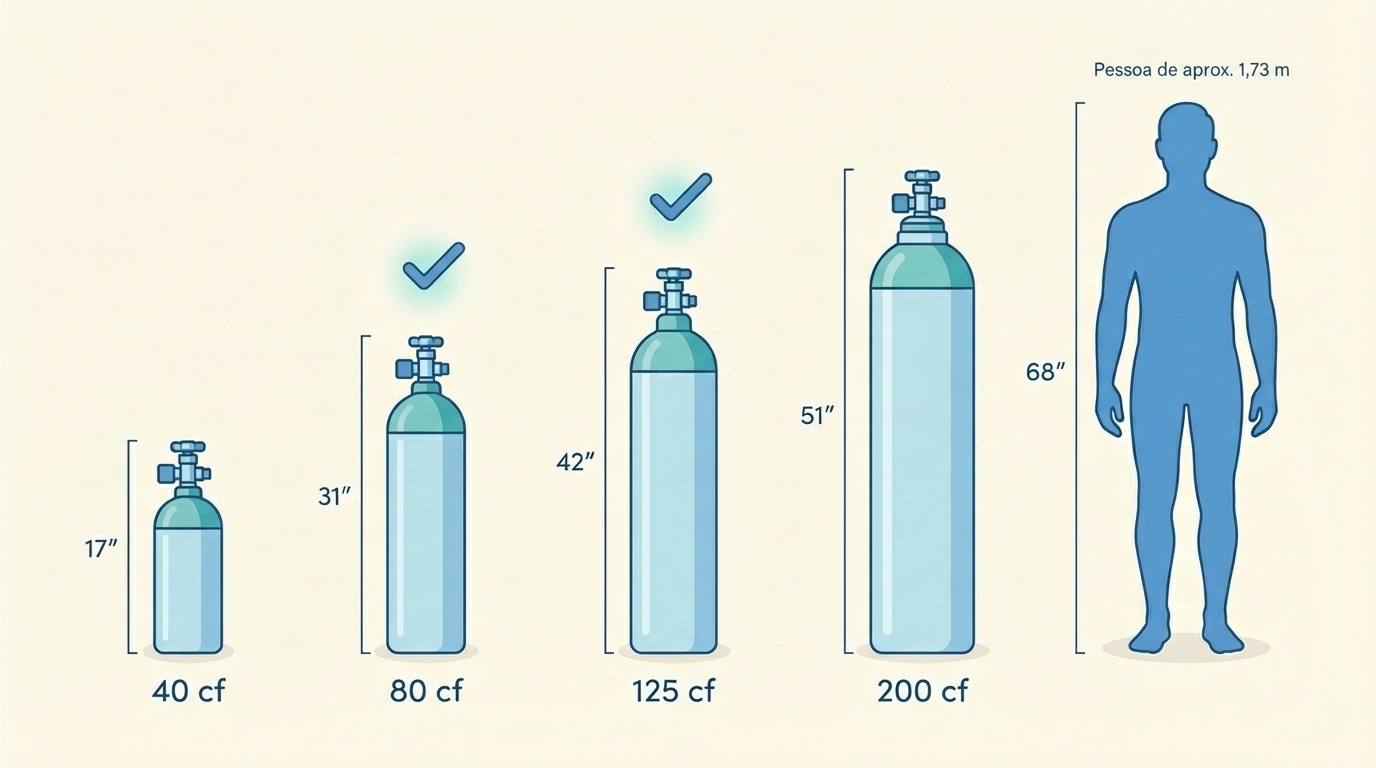 Comparação de tamanhos de cilindros. Os tamanhos de 80 e 125 cf são os mais populares para uso doméstico. O de 200 cf contém muito mais gás, mas exige um carrinho.
Passo 3: Obtenha um regulador, equipamento de respiração e mangueira
Os reguladores e as conexões podem diferir entre o oxigênio medicinal e o para solda. Explicamos isso logo abaixo. Confira o capítulo Equipamento para o restante do passo a passo:
- Equipamento de respiração: válvula de demanda, kit ClusterO2 ou máscara não reinalante.
- Montagem e teste: o procedimento de 10 minutos para juntar tudo.
- Segurança em casa: as regras de segurança contra incêndio que se aplicam a qualquer configuração de oxigênio.
Regulador e conexões
Entrada. A entrada do seu regulador precisa combinar com a válvula do seu cilindro. Nos EUA e no Canadá, todos os tamanhos de cilindros para solda usam CGA 540 (uma rosca grande). Fora da América do Norte, veja a tabela de entradas em Equipamento § Reguladores, conexões e mangueira e confirme com o seu fornecedor antes de comprar.
Tipo de regulador. Como descrito no capítulo Equipamento, existem dois tipos de reguladores: reguladores de fluxo (com um seletor de litros por minuto (LPM)) e reguladores de pressão. Ambos estão disponíveis em versões de uso para solda. Os reguladores de pressão para solda têm uma pressão de saída ajustável, enquanto os reguladores de pressão medicinais fornecem uma pressão constante combinada com uma válvula de demanda.
Opção 1: Regulador de pressão para solda. Necessário se você usar uma válvula de demanda, e também funciona com um kit ClusterO2 ou máscara não reinalante (NRB): aumente a pressão de saída até que a bolsa reservatório se reabasteça rápido o suficiente para acompanhar sua respiração (veja Uso § Técnicas de respiração). Exemplos de modelos:
- Regulador de Solda IMAGE CGA 540 (~US$ 25)
- Regulador de Solda Yaetek CGA 540 (~US$ 25)
Seu regulador de solda pode não vir com a saída de que você precisa:
- Com uma válvula de demanda, a saída precisa se conectar à mangueira da sua válvula de demanda. Nos EUA, isso costuma ser uma rosca DISS. Exemplo: adaptador de espigão para DISS.
- Com uma NRB ou kit ClusterO2, a saída precisa ser um espigão (barb) para a mangueira de oxigênio padrão.
Opção 2: Regulador de fluxo. Um regulador de fluxo com seletor de LPM funciona com uma NRB ou kit ClusterO2, mas não com uma válvula de demanda (que precisa de uma pressão de entrada definida). Uma escolha comum nos EUA é o regulador Responsive Respiratory 25 LPM CGA 540.
Fora dos EUA, pergunte ao seu fornecedor de solda ou a uma comunidade local de cefaleia em salvas qual marca de regulador é comumente usada no seu país com o conector apropriado.
Resumo de custos
Os preços abaixo estão em USD e refletem o mercado dos EUA. Os preços em outros países variam; use esta tabela como uma estrutura (aluguel + enchimentos + equipamento único) e não como um guia direto para custos locais.
| Item | Custo aproximado | Notas |
|---|---|---|
| Aluguel de cilindro (mensal) | US$ 15–25/mês | Ou compra definitiva por US$ 100–200+ |
| Enchimento do cilindro | US$ 20–40 por enchimento | Depende do tamanho |
| Regulador (CGA 540) | US$ 20–70 | Compra única; tipo solda ~US$ 20–30, medicinal LPM ~US$ 30–70 |
| Kit ClusterO2 | ~US$ 32 | Ou NRB padrão por ~US$ 5 |
| Válvula de demanda (melhoria opcional) | US$ 250–400+ | Uso mais eficiente de O₂ |
| Mangueira de oxigênio | ~US$ 5 | Padrão de 7 pés (~2 m) |
| Carrinho ou alça para cilindro | US$ 30–60 | Compra única; opcional, mas recomendado |
| Total do primeiro mês (máscara) | ~US$ 125–230 | Com kit ClusterO2 ou NRB |
| Total do primeiro mês (válvula de demanda) | ~US$ 375–600+ | Com válvula de demanda |
| Mensal contínuo | ~US$ 35–65 | Aluguel + 1 reabastecimento; ciclos intensos custam mais |
Compare: o oxigênio medicinal por meio de um fornecedor DME sem seguro frequentemente custa US$ 200–400+ por mês. Durante ciclos intensos, você pode precisar de vários reabastecimentos por semana, o que pode elevar os custos contínuos do oxigênio para solda acima de US$ 100/mês, ainda bem abaixo da rota medicinal.
Dicas da comunidade
A 25 LPM, um tanque de 80 cf dá cerca de 90 minutos de uso total. Durante ciclos intensos, você pode precisar de vários reabastecimentos por semana, e é por isso que cilindros maiores valem o esforço.
Monte tudo antes de um ciclo começar. Teste a configuração uma vez e depois mantenha-a em um local onde você possa pegá-la no momento em que um ataque começar.
O equipamento de respiração faz diferença. Em ordem aproximada de eficácia: válvula de demanda, depois kit ClusterO2, depois NRB com as válvulas laterais fechadas com fita, depois NRB básica. Melhore o equipamento quando puder (veja Equipamento § Equipamento de respiração).
Verifique a configuração de vez em quando. Mantenha um regulador ou máscara reserva, se puder.
Lave a máscara, o bocal ou a válvula de demanda em água morna com sabão regularmente para que a sujeira não se acumule. Troque as peças usadas.
Referências (8)
- ↩ Rozen TD (2011). Inhaled oxygen and cluster headache sufferers in the United States: use, efficacy and economics: results from the United States Cluster Headache Survey. Headache, 51(4). Link
- ↩ Burman F (2022). Do I Need Medical Grade Oxygen?. Alert Diver. Link
- ↩ Mo H et al. (2022). Oxygen therapy for headache disorders: a comprehensive review. Pain Physician. Link
- ↩ ClusterBusters forum (2016). Welding Oxygen. ClusterBusters. Link
- ↩ ClusterBusters forum (2017). Welding Oxygen Usage Feedback. ClusterBusters. Link
- ↩ FDA (2024). Current Good Manufacturing Practice, Certification, Postmarketing Safety Reporting, and Labeling for Medical Gases. Federal Register. Link
- ↩ FDA (2016). Medical Gas Containers and Closures; Current Good Manufacturing Practice Requirements. Federal Register. Link
- ↩ Cluster Headache Warriors (2024). Welder's O2 — A Last Resort. Cluster Headache Warriors. Link
Este guia ensinou algo que você vai colocar em prática?
Isenção de Responsabilidade
As informações deste site são fornecidas apenas para fins educacionais e de redução de danos. Elas não constituem aconselhamento médico e não devem substituir a consulta com um profissional de saúde qualificado. Consulte nossa página Aviso Legal para mais detalhes.