Esta página é uma tradução gerada por IA do guia em inglês. Se você é falante nativo de português, ajude-nos a melhorar esta tradução entrando em contato.
Abortar ataques de cefaleia em salvas com oxigênio em alto fluxo
Um guia completo para usar oxigênio em alto fluxo para abortar ataques de cefaleia em salvas: como funciona, como usá-lo bem e como conseguir acesso.

Escrito por Nicolas Macé, PhD
Oxigênio: o tratamento legal padrão-ouro
O oxigênio em alto fluxo é o tratamento legal mais seguro para abortar ataques de cefaleia em salvas. Em estudos controlados, cerca de quatro em cada cinco pacientes que respondem ao tratamento interrompem um ataque em até 15 minutos após iniciar a inalação, sem efeitos colaterais nem cefaleias de rebote.[1] Muitos pacientes relatam interromper ataques com oxigênio em menos de 10 minutos. Ele é reconhecido como tratamento agudo de primeira linha pela European Academy of Neurology (EAN).[2]
O oxigênio é incomum entre os tratamentos médicos: a rapidez com que ele funciona, e até se funciona ou não, depende muito de como você o usa. Encontrar o equipamento, o contexto de uso e a técnica que funcionam para você pode ser um verdadeiro desafio. Este guia existe para ajudar você nisso.
Quem está por aqui há tempo suficiente aprendeu que, quando alguém diz que tentou oxigênio e não funcionou […], é muito, muito provável que a forma como usou o oxigênio estivesse longe do ideal, e talvez valha muito a pena tentar de novo. […] Muita gente que achava que o O2 não funcionava para ela descobriu que funciona bem quando feito "do jeito certo".
— CHfather, moderador de longa data do fórum ClusterBusters
Em resumo: as melhores configurações e técnicas de oxigênio
Em todos os casos, você precisará de um cilindro de oxigênio puro pressurizado. A partir daí, duas configurações de equipamento são conhecidas por funcionar bem, cada uma combinada com sua própria técnica de respiração:
| Configuração | Prós e contras | Técnica de respiração |
|---|---|---|
| Configuração com válvula de demanda | Uma válvula de demanda libera oxigênio quando você inspira (tão rápido quanto consegue respirar), tornando-a a forma mais rápida de abortar um ataque com oxigênio. Pode ser mais difícil de conseguir por prescrição e mais cara do que a alternativa. | Hiperventile com oxigênio puro: inspiração completa, expiração completa, repita o mais rápido possível. |
| Máscara não reinalante com reservatório e um regulador de fluxo suficientemente alto (explicado logo abaixo). | Funciona bem para a maioria das pessoas, com o regulador certo (25 LPM ou mais é recomendado) e uma boa técnica de respiração. Geralmente é mais fácil de conseguir por prescrição do que uma válvula de demanda. Com fluxo suficiente, aborta ataques quase tão rapidamente quanto uma válvula de demanda; com fluxo mais baixo, a pausa entre respirações para a bolsa reservatório encher pode tornar a ação um pouco mais lenta. | Respiração profunda e forçada: esvazie os pulmões, depois inspire profundamente o oxigênio puro. Repita no ritmo mais rápido que a bolsa reservatório conseguir acompanhar. Só faça pausa entre respirações se a bolsa ainda não tiver enchido. |
Um regulador é a peça que se conecta ao cilindro de oxigênio e controla quanto oxigênio é liberado, medido em litros por minuto (LPM).
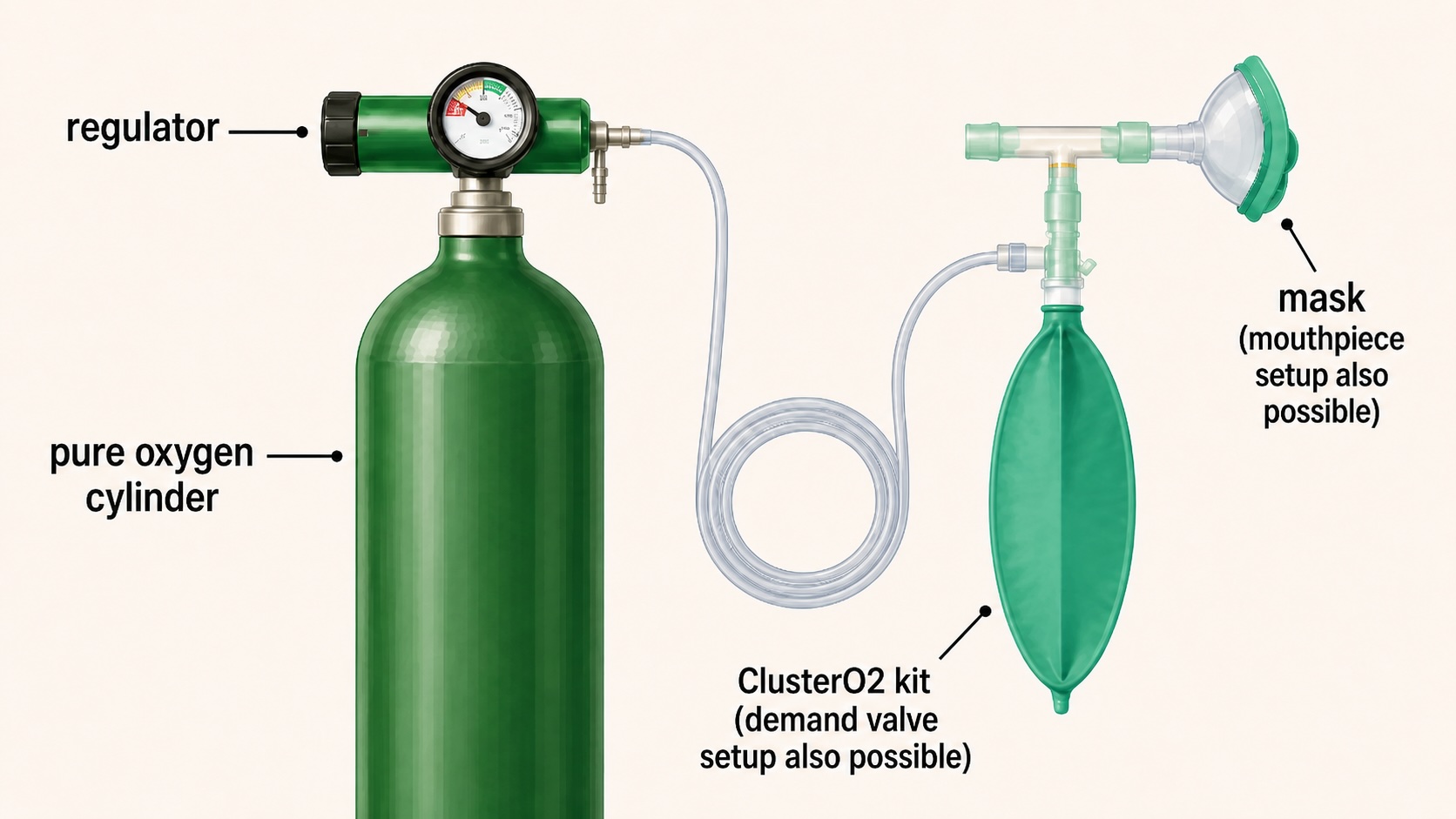
As duas configurações e técnicas de respiração que funcionam
Configuração com válvula de demanda
Uma válvula de demanda libera oxigênio apenas quando você inspira, e consegue acompanhar uma respiração muito rápida.
A técnica de respiração. Com uma válvula de demanda, você hiperventila com oxigênio puro: inspire totalmente, expire totalmente, e repita o mais rápido que conseguir. Esta é amplamente considerada a forma mais rápida e fácil de abortar um ataque de cefaleia em salvas com oxigênio. Em um ensaio randomizado cruzado, as válvulas de demanda reduziram aproximadamente pela metade a necessidade de medicação de resgate em comparação com uma máscara padrão, e a maioria dos pacientes as preferiu.[3]
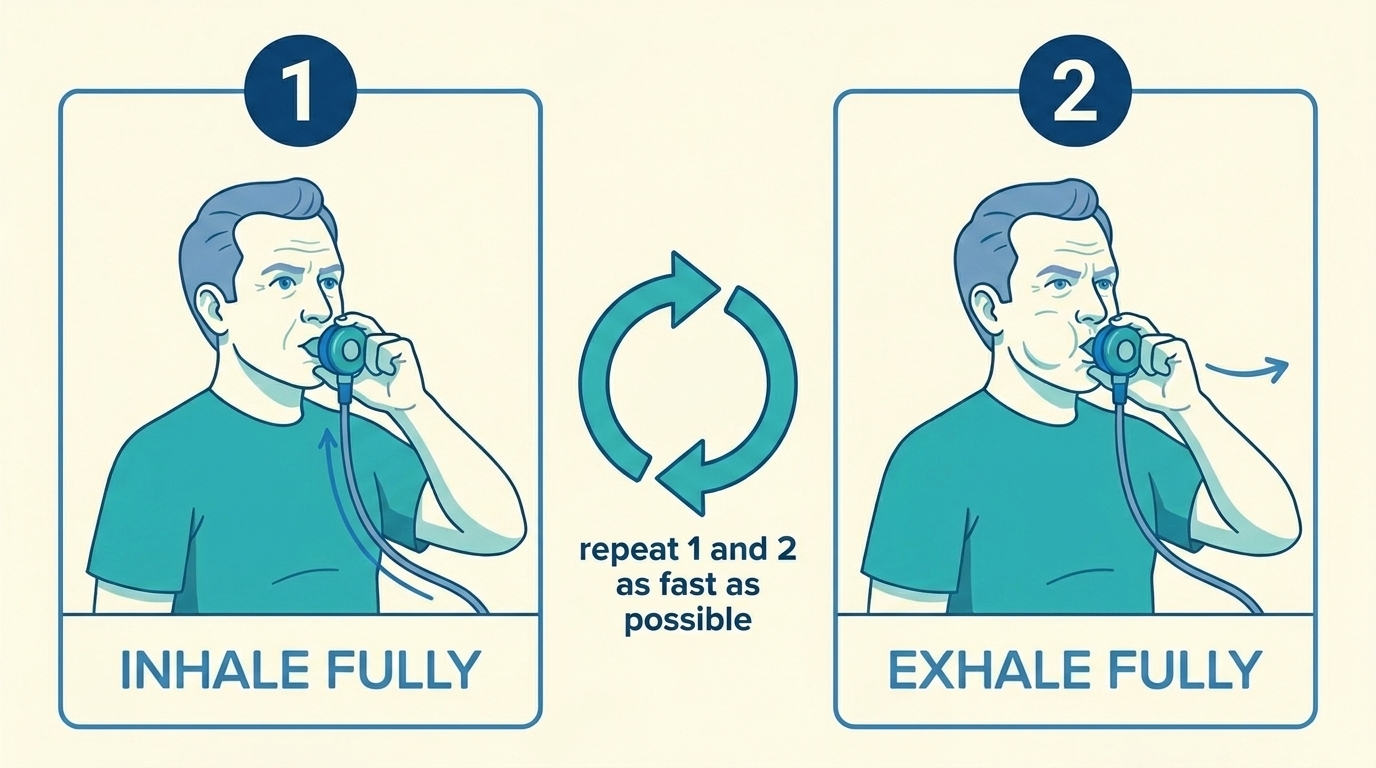 Técnica com válvula de demanda: inspire totalmente, expire totalmente, repita o mais rápido que conseguir.
Vídeo de demonstração da técnica de hiperventilação com uma válvula de demanda.
A configuração. Uma válvula de demanda normalmente requer um regulador de pressão. Ele é diferente do regulador de fluxo padrão (também chamado de regulador LPM) usado com máscaras não reinalantes. E as válvulas de demanda em si são caras, o que significa que podem ser mais difíceis de conseguir por prescrição. Por isso, alguns pacientes optam por não seguir a via da prescrição e conseguem oxigênio e equipamento em fornecedores de materiais para solda. Veja nosso guia de oxigênio de solda.
Configuração com bolsa reservatório: kit ClusterO2 ou máscara não reinalante
Um kit ClusterO2 ou uma máscara não reinalante padrão usa uma bolsa reservatório. O oxigênio flui para dentro da bolsa continuamente, e você respira da bolsa por uma máscara ou bocal. Esta configuração funciona bem para a maioria das pessoas, e costuma ser mais fácil de conseguir por prescrição do que uma válvula de demanda. Porém, a bolsa armazena uma reserva limitada de oxigênio puro: se você respirar mais rápido do que o regulador consegue reabastecê-la, a bolsa esvazia e você precisa esperar que ela encha de novo. Por isso é importante conseguir um regulador que chegue ao maior fluxo possível.
A técnica de respiração. Esvazie os pulmões com toda a força que conseguir, depois faça uma inspiração profunda, enchendo os pulmões com oxigênio puro. O ritmo depende do seu fluxo. Se a bolsa reservatório permanecer cheia entre as respirações, respire o mais rápido que for capaz, no mesmo ritmo de uma válvula de demanda. Se a bolsa começar a esvaziar, faça uma breve pausa entre as respirações para dar tempo de ela encher.
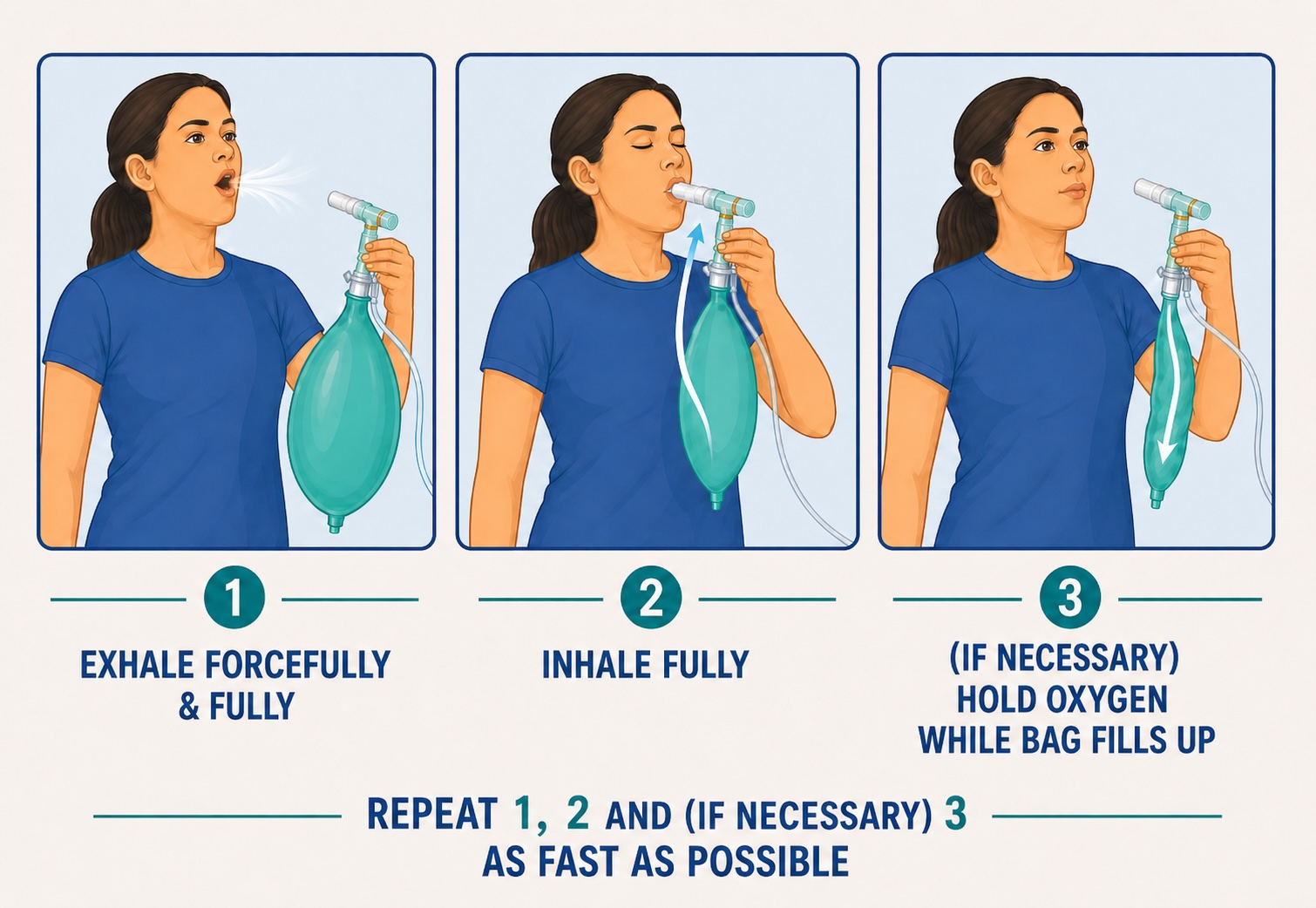 Técnica de respiração profunda: expire completamente, inspire oxigênio puro, repita assim que a bolsa encher.
Vídeo de demonstração da técnica de respiração profunda com um kit ClusterO2.
A configuração. A escolha mais importante é o regulador. No mínimo 25 LPM é fortemente recomendado. Reguladores que fornecem 40 LPM costumam estar disponíveis e ser baratos, e com esse fluxo a configuração pode abortar ataques quase tão rapidamente quanto uma válvula de demanda (ao custo de usar mais oxigênio por ataque). O fluxo certo varia entre pessoas; você vai ajustá-lo conforme refina sua técnica. Veja Abortando um ataque com oxigênio para saber como.
O que evitar
Para abortar um ataque, o gás que você respira precisa ser oxigênio puro, sem diluição. Isso significa três coisas a evitar:
- Concentradores de oxigênio. Produzem oxigênio com pureza menor e a uma taxa de fluxo baixa demais para abortar ataques de cefaleia em salvas. O gás precisa vir de um cilindro de oxigênio puro.
- Cânulas nasais e máscaras com aberturas laterais. Permitem que o ar ambiente se misture ao oxigênio que você inspira. Se sua máscara não reinalante prescrita tiver aberturas laterais, você pode bloqueá-las. Veja o capítulo Equipamento.
- Máscaras sem bolsa reservatório (máscaras faciais simples). Sem uma bolsa para armazenar uma reserva de oxigênio puro entre as respirações, a máscara não consegue fornecer oxigênio suficiente na inspiração para encher completamente seus pulmões.
Referências (3)
- ↩ Cohen AS, Burns B, Goadsby PJ (2009). High-flow oxygen for treatment of cluster headache: a randomized trial. JAMA, 302(22), 2451–2457. Link
- ↩ May A, Evers S, Goadsby PJ, Leone M, Manzoni GC, Pascual J, et al. (2023). European Academy of Neurology guidelines on the treatment of cluster headache. European Journal of Neurology, 30(10), 2955–2979. doi:10.1111/ene.15956
- ↩ Petersen AS, Barloese MCJ, Lund NLT, Jensen RH (2017). Oxygen therapy for cluster headache. A mask comparison trial. A single-blinded, placebo-controlled, crossover study. Cephalalgia, 37(3), 214–224. doi:10.1177/0333102416637817
Este guia ensinou algo que você vai colocar em prática?
Capítulos
- 1. Abortar um ataque com oxigênioComo usar oxigênio durante um ataque de cefaleia em salvas. Quando bem aplicado, encerra a dor em poucos minutos para a maioria dos pacientes. Quando não funciona, o problema costuma estar no equipamento, no fluxo ou na técnica de respiração, e todos esses pontos podem ser corrigidos.
- 2. EquipamentoO que cada peça do conjunto faz, e como escolhê-las e montá-las.
- 3. Como conseguir acesso ao oxigênioComo conseguir que o oxigênio domiciliar seja prescrito, entregue e coberto, com caminhos de recurso e alternativas para cada ponto em que o processo pode travar.
- 4. Oxigênio para solda: uma rota mais barata e sem prescriçãoQuando você não consegue oxigênio medicinal para abortar ataques de cefaleia em salvas: o que é o oxigênio para solda, por que é seguro e como obtê-lo.
- 5. Perguntas frequentesRespostas curtas para as perguntas mais comuns dos pacientes sobre oxigenoterapia para cefaleia em salvas. A cobertura mais aprofundada de cada tópico está nas sub-páginas correspondentes; os links estão incluídos ao longo do texto.
Isenção de Responsabilidade
As informações deste site são fornecidas apenas para fins educacionais e de redução de danos. Elas não constituem aconselhamento médico e não devem substituir a consulta com um profissional de saúde qualificado. Consulte nossa página Aviso Legal para mais detalhes.