Oxygène de soudure : une option moins chère et sans ordonnance
Quand vous ne pouvez pas obtenir d'oxygène médical pour stopper les crises d'AVF : qu'est-ce que l'oxygène de soudure, pourquoi il est sûr, et comment vous en procurer.

Rédigé par Nicolas Macé, PhD
Obtenir de l'oxygène médical est souvent lent et parfois coûteux. Une enquête de 2011 a révélé que 41 % des patients américains à qui on avait prescrit de l'oxygène à domicile s'étaient vu refuser la prise en charge par leur assurance,[1] et l'oxygène fourni par un revendeur d'équipement médical durable (DME) aux États-Unis, sans assurance, coûte entre 200 et 400 $ (USD) par mois.
L'oxygène de soudure est une solution de contournement courante. Il est vendu dans les magasins de fourniture de soudure, ne nécessite aucune ordonnance et coûte une fraction du prix de la voie médicale. Dans la même enquête de 2011, 12 % des patients américains l'utilisaient déjà,[1] et les fils de discussion de Clusterbusters documentent cette pratique depuis plus d'une décennie.
Ce chapitre est principalement destiné aux lecteurs des États-Unis, où le coût élevé de l'oxygène médical a fait de l'oxygène de soudure une solution de contournement courante. Les détails comme les fournisseurs, le dimensionnement des bouteilles, les raccords et les prix diffèrent selon la région. Les différences régionales majeures sont signalées au fil du texte ; nous pourrons ajouter ultérieurement des conseils dédiés à d'autres régions.
Ce chapitre couvre ce qui est spécifique à l'oxygène de soudure : la sécurité des gaz de soudure, comment trouver un fournisseur, et comment les bouteilles de soudure sont dimensionnées et tarifées. L'équipement lui-même (détendeurs, masques, valves à la demande, montage, sécurité à domicile) est le même que pour la voie médicale et se trouve dans le chapitre Équipement. Lisez ce chapitre en parallèle de celui-ci.
L'oxygène de soudure est généralement sans risque à respirer
Les informations ci-dessous s'appliquent aux États-Unis, au Canada, à l'Europe et à l'Australie/Nouvelle-Zélande. Dans d'autres régions, l'oxygène peut être moins pur, et les pratiques de manipulation des bouteilles peuvent être moins strictement contrôlées. Si vous vous procurez de l'oxygène de soudure en dehors de ces régions, renseignez-vous sur la méthode de production de votre fournisseur et soyez particulièrement attentif à la pureté du gaz et à l'intégrité de la bouteille (vérifier si la bouteille a été utilisée pour d'autres gaz ou correctement purgée avant remplissage).
Le gaz est le même
L'oxygène médical et l'oxygène de soudure sont produits par le même procédé industriel. Dans de nombreuses installations, le gaz provient de la même cuve. La différence entre ce qui est étiqueté "médical" et ce qui est étiqueté "soudure" est principalement administrative.
L'oxygène médical (grade USP aux États-Unis, grade Ph. Eur. en Europe) doit être pur à au moins 99,0 % (la Ph. Eur. exige 99,5 %). En pratique, l'oxygène de soudure est généralement pur à au moins 99,5 % ; les usines modernes de séparation de l'air n'ont tout simplement pas de chaîne de production séparée. Comme l'a conclu Francois Burman, ingénieur professionnel chez Divers Alert Network, après avoir enquêté sur cette question pour la plongée sous-marine :[2]
L'oxygène est de l'oxygène, et si la pureté dépasse 99 pour cent, il est sans risque à utiliser là où de l'oxygène pur est requis.
Aucun préjudice documenté
Aucun événement indésirable lié à l'inhalation d'oxygène de soudure n'apparaît dans la littérature médicale, les bases de données de la FDA, ou les rapports de la communauté des patients. Une revue de 2022 portant sur l'ensemble des données probantes concernant l'oxygénothérapie pour les céphalées n'a cité aucun rapport d'effets indésirables lié à cette pratique.[3] Les fils de discussion du forum Clusterbusters documentent des patients utilisant de l'oxygène de soudure depuis des années sans effets indésirables.[4][5] Les incidents liés aux bouteilles documentés dans les archives de la FDA (mélanges de gaz et contamination par des solvants) sont en fait survenus avec des bouteilles médicales en milieu médical, pas avec de l'oxygène de soudure utilisé par des patients atteints d'AVF (algie vasculaire de la face) ou par des plongeurs.[6][7]
La seule véritable considération de sécurité avec tout type d'oxygène est le risque d'incendie, et cela ne diffère pas pour l'oxygène de soudure. L'oxygène fait brûler les feux plus vite et plus chaud, c'est pourquoi les précautions simples à domicile décrites dans le chapitre Équipement § Sécurité à domicile s'appliquent également ici.
Manipulation des bouteilles
Les bouteilles médicales sont nettoyées, vidées et inspectées avant chaque remplissage, conformément aux règles de la FDA. Les bouteilles de soudure ne sont pas soumises à ces règles ; en théorie, une bouteille de soudure pourrait conserver des traces de contenus précédents ou développer de l'humidité interne avec le temps. En pratique, les bouteilles d'oxygène provenant de fournisseurs réputés sont dédiées à l'oxygène et manipulées avec soin, car la contamination est aussi un risque de sécurité pour la soudure.
Il est donc recommandé de demander aux fournisseurs de purger la bouteille avant qu'elle ne soit remplie, ce qui élimine toute humidité résiduelle ou trace de contenu précédent.[8] Les fournisseurs réputés le font systématiquement, mais vous pouvez le demander pour être certain.
À quoi ressemble cette option
L'installation comporte les mêmes quatre composants que la voie médicale (bouteille, détendeur, équipement respiratoire, tuyau ; voir le chapitre Équipement pour les détails). Les deux choses spécifiques à la soudure à bien faire sont de trouver un fournisseur et de choisir la taille de la bouteille. Le coût total pour s'équiper est d'environ 125 à 230 $ avec un masque, ou 375 à 600 $+ avec une valve à la demande. Les coûts récurrents sont d'environ 35 à 65 $ par mois (location de la bouteille plus un remplissage). À comparer avec 200 à 400 $+ par mois pour de l'oxygène médical via un revendeur DME sans assurance. Voir le récapitulatif des coûts ci-dessous pour les détails complets.
Obtenir votre installation, étape par étape
Étape 1 : Trouver un fournisseur
Aux États-Unis, les fournisseurs courants sont Airgas et Linde. Les autres options incluent les magasins locaux de fourniture de soudure, les magasins de fournitures agricoles et les distributeurs de gaz industriels.
Ne dites pas au fournisseur que vous avez l'intention de respirer l'oxygène. Si vous révélez votre intention de l'inhaler, le fournisseur peut refuser de vous le vendre car il n'est pas autorisé à vendre du gaz respiratoire sans ordonnance, et ne voudra sûrement pas en assumer la responsabilité.
Vous devrez soit louer une bouteille, soit en acheter une. Certains points de vente exigent l'ouverture d'un compte client de base (nom, adresse, carte de crédit) ; d'autres acceptent les clients sans rendez-vous. Aux États-Unis, certaines grandes chaînes exigent un compte commercial avec un numéro fiscal pour les bouteilles de plus de 40 pieds cubes ; les règles varient selon les agences, alors appelez à l'avance.
Si une agence vous pose problème, essayez un petit magasin indépendant ou un magasin de fournitures agricoles. Ils sont souvent plus flexibles que les succursales de grands groupes.
Location ou achat
- La location est plus simple pour la plupart des gens : environ 15 à 25 $/mois. Vous échangez une bouteille vide contre une pleine ; le fournisseur entretient la bouteille.
- L'achat évite les frais de location récurrents (100 à 200 $+ pour la bouteille), mais en tant que propriétaire, vous serez responsable des tests hydrostatiques périodiques (tous les 5 ans pour les bouteilles en acier selon les règles du US DOT, généralement tous les 10 ans selon la directive TPED de l'UE et la réglementation britannique). Les bouteilles achetées sont remplies sur place plutôt qu'échangées.
Étape 2 : Choisir vos bouteilles
Aux États-Unis, les bouteilles de soudure sont vendues selon leur capacité en pieds cubes (cf) de gaz. En Europe et au Royaume-Uni, les mêmes bouteilles sont vendues selon leur capacité en eau (le volume interne de la bouteille vide), en litres. Par exemple, une bouteille de 6 L de capacité en eau remplie à 200 bar contient environ 1 200 L de gaz, soit à peu près l'équivalent d'une bouteille américaine de 40 cf. Consultez le tableau ci-dessous pour d'autres exemples.
Prenez la plus grande bouteille que vous pouvez raisonnablement transporter chez vous. Une bouteille plus grande signifie moins de trajets pour la remplir et moins de risque de vous retrouver à court d'oxygène pendant un cycle actif. La décision se résume à ce que vous pouvez physiquement gérer : pouvez-vous la porter dans les escaliers ? Tient-elle dans votre voiture ? Voir le tableau ci-dessous pour les dimensions et le poids des bouteilles courantes.
Gardez au moins deux bouteilles pour ne pas vous retrouver à court d'oxygène pendant un cycle actif. Une configuration courante est une grande bouteille à la maison plus une bouteille plus petite portable (40 ou 60 cf, soit environ 6 à 9 L de capacité en eau dans la terminologie UE/Royaume-Uni).
Voici les tailles les plus courantes :
| Capacité en eau (UE/RU) | Capacité en gaz | Hauteur × diamètre | Poids (pleine) | Crises traitables approx.¹ |
|---|---|---|---|---|
| ~6 L | 40 cf / ~1 133 L | 17″ × 7″ (43 × 18 cm) | ~27 lbs (12 kg) | ~3 |
| ~11 L | 80 cf / ~2 265 L | 31″ × 7″ (79 × 18 cm) | ~56 lbs (25 kg) | ~6 |
| ~18 L | 125 cf / ~3 540 L | 42″ × 7″ (107 × 18 cm) | ~75 lbs (34 kg) | ~9 |
| ~35 L | 200 cf / ~7 079 L | 51″ × 9″ (130 × 23 cm) | ~128 lbs (58 kg) | ~19 |
¹ Nombre approximatif de crises pouvant être traitées avec une séance de 15 minutes à 25 litres par minute (L/min), soit 375 litres chacune. Les chiffres de capacité en eau UE/RU sont calculés à partir de la capacité en gaz en supposant une pression de remplissage de 200 bar (capacité en eau ≈ capacité en gaz ÷ 200). Certaines bouteilles UE/RU se remplissent à des pressions plus élevées (par exemple, la BOC ZH est à 300 bar), de sorte qu'une bouteille UE réelle contenant le même volume de gaz peut avoir une capacité en eau plus petite.
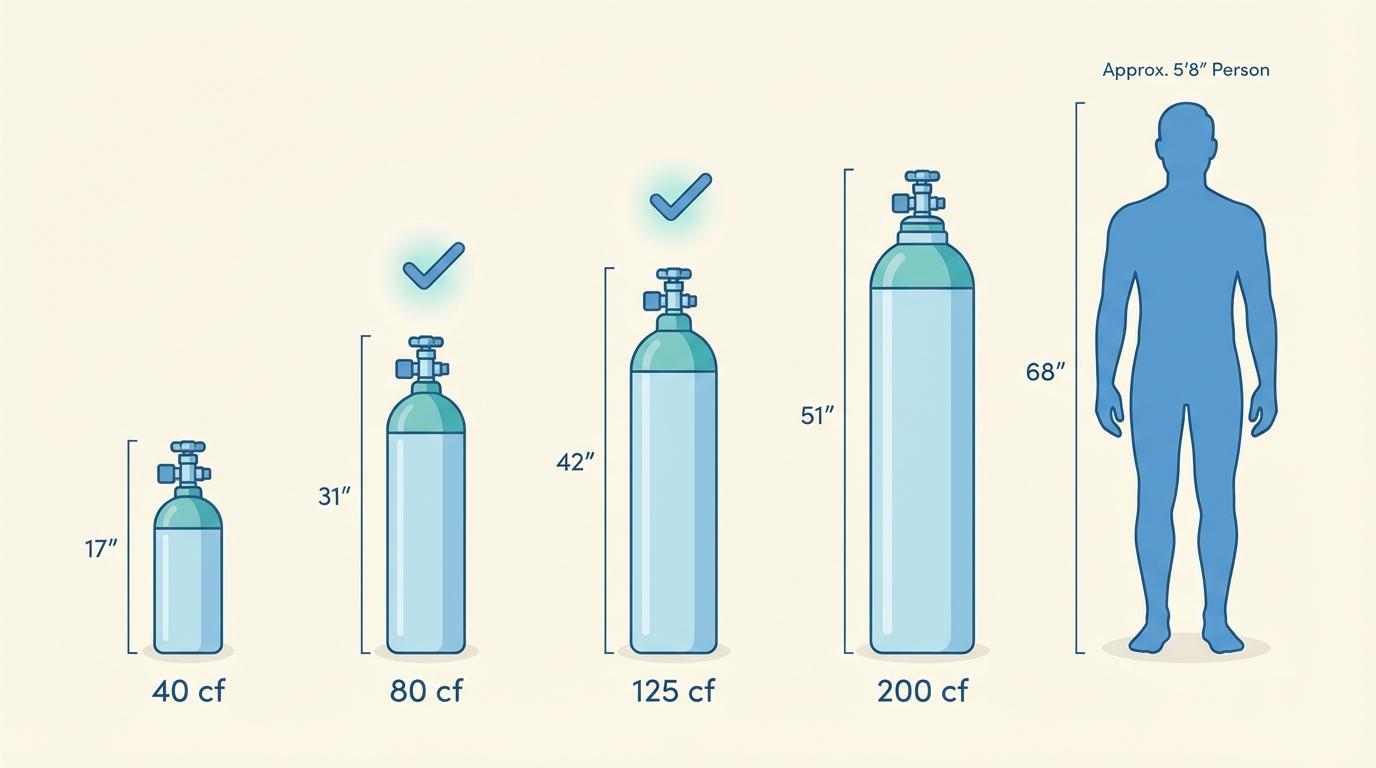 Comparaison des tailles de bouteilles. Les tailles 80 et 125 cf sont les plus populaires pour un usage à domicile. La bouteille de 200 cf contient beaucoup plus de gaz mais nécessite un chariot.
Étape 3 : Procurez-vous un détendeur, un équipement respiratoire et un tuyau
Les détendeurs et raccords peuvent différer entre oxygène médical et oxygène de soudure. Ils sont expliqués ci-dessous. Consultez le chapitre Équipement pour le reste du parcours :
- Équipement respiratoire : valve à la demande, kit ClusterO2, ou masque à haute concentration.
- Montage et test : la procédure de 10 minutes pour tout assembler.
- Sécurité à domicile : les règles de sécurité incendie qui s'appliquent à toute installation d'oxygène.
Détendeur et raccords
Entrée. L'entrée de votre détendeur doit correspondre au robinet de votre bouteille. Aux États-Unis et au Canada, toutes les tailles de bouteilles de soudure utilisent le raccord CGA 540 (un grand pas de vis). Hors Amérique du Nord, consultez le tableau des entrées dans la section Équipement § Détendeurs, raccords et tuyaux et confirmez avec votre fournisseur avant d'acheter.
Type de détendeur. Comme expliqué dans le chapitre Équipement, il existe deux types de détendeurs : les détendeurs-débitmètres (avec une molette en litres par minute (L/min)) et les détendeurs à pression. Les deux sont disponibles en versions pour soudure. Les détendeurs à pression variable pour soudure ont une pression de sortie réglable, tandis que les détendeurs à pression fixe (médicaux) délivrent une pression constante adaptée à une valve à la demande.
Option 1 : détendeur à pression variable pour soudure. Indispensable si vous utilisez une valve à la demande, et fonctionne également avec un kit ClusterO2 ou un masque à haute concentration (MHC) : montez la pression de sortie jusqu'à ce que le sac se remplisse assez vite pour suivre votre respiration (voir Utilisation § Techniques respiratoires). Exemples de modèles :
- IMAGE CGA 540 Welding Regulator (~25 $)
- Yaetek CGA 540 Welding Regulator (~25 $)
Votre détendeur de soudure n'a peut-être pas la sortie dont vous avez besoin :
- Avec une valve à la demande, la sortie doit se raccorder au tuyau de la valve à la demande. Aux États-Unis, ce sera souvent un DISS fileté. Exemple d'adaptateur barbelé vers DISS.
- Avec un MHC ou un kit ClusterO2, la sortie doit être un embout barbelé pour tuyau d'oxygène standard.
Option 2 : Détendeur-débitmètre. Un détendeur-débitmètre avec une molette en L/min fonctionne avec un MHC ou un kit ClusterO2, mais pas avec une valve à la demande (qui nécessite une pression d'entrée fixe). Un choix courant aux États-Unis est le détendeur Responsive Respiratory 25 L/min CGA 540.
Hors des États-Unis, demandez à votre fournisseur de soudure ou à une communauté locale d'AVF une marque de détendeur couramment utilisée dans votre pays avec le raccord approprié.
Récapitulatif des coûts
Les prix ci-dessous sont en USD et reflètent le marché américain. Les prix dans d'autres pays varient ; utilisez ce tableau comme structure (location + remplissages + équipement ponctuel) plutôt que comme guide direct des coûts locaux.
| Élément | Coût approximatif | Notes |
|---|---|---|
| Location de bouteille (mensuelle) | 15 à 25 $/mois | Ou achat ferme pour 100 à 200 $+ |
| Remplissage de la bouteille | 20 à 40 $ par remplissage | Selon la taille |
| Détendeur (CGA 540) | 20 à 70 $ | Ponctuel ; type soudure ~20 à 30 $, médical L/min ~30 à 70 $ |
| Kit ClusterO2 | ~32 $ | Ou MHC standard pour ~5 $ |
| Valve à la demande (option recommandée) | 250 à 400 $+ | Utilisation la plus efficace de l'O₂ |
| Tuyau d'oxygène | ~5 $ | Standard de 7 pieds (~2 m) |
| Chariot ou sangle pour bouteille | 30 à 60 $ | Ponctuel ; optionnel mais recommandé |
| Total premier mois (masque) | ~125 à 230 $ | Avec kit ClusterO2 ou MHC |
| Total premier mois (valve à la demande) | ~375 à 600 $+ | Avec valve à la demande |
| Coût mensuel récurrent | ~35 à 65 $ | Location + 1 remplissage ; les cycles intenses coûtent plus cher |
À comparer : l'oxygène médical via un fournisseur DME sans assurance coûte souvent 200 à 400 $+ par mois. Pendant les cycles d'AVF intenses, vous pouvez avoir besoin de plusieurs remplissages par semaine, ce qui peut faire grimper les coûts récurrents de l'oxygène de soudure au-dessus de 100 $/mois, ce qui reste bien inférieur à la voie médicale.
Conseils de la communauté
À 25 L/min, une bouteille de 80 cf vous donne environ 90 minutes d'utilisation totale. Pendant les cycles d'AVF intenses, vous pouvez avoir besoin de plusieurs remplissages par semaine, c'est pourquoi les grandes bouteilles valent l'effort.
Installez votre équipement avant le début d'un cycle. Testez l'installation une fois, puis gardez-la quelque part où vous pouvez facilement y accéder dès qu'une crise commence.
L'équipement respiratoire compte. Par ordre d'efficacité approximatif : valve à la demande, puis kit ClusterO2, puis MHC avec évents scotchés, puis MHC basique. Améliorez votre équipement quand vous le pouvez (voir Équipement § Équipement respiratoire).
Vérifiez l'installation de temps en temps. Gardez un détendeur ou un masque de rechange si possible.
Lavez régulièrement le masque, l'embout buccal ou la valve à la demande dans de l'eau chaude savonneuse pour éviter l'accumulation de saletés. Remplacez les pièces usagées.
Références (8)
- ↩ Rozen TD (2011). Inhaled oxygen and cluster headache sufferers in the United States: use, efficacy and economics: results from the United States Cluster Headache Survey. Headache, 51(4). Link
- ↩ Burman F (2022). Do I Need Medical Grade Oxygen?. Alert Diver. Link
- ↩ Mo H et al. (2022). Oxygen therapy for headache disorders: a comprehensive review. Pain Physician. Link
- ↩ ClusterBusters forum (2016). Welding Oxygen. ClusterBusters. Link
- ↩ ClusterBusters forum (2017). Welding Oxygen Usage Feedback. ClusterBusters. Link
- ↩ FDA (2024). Current Good Manufacturing Practice, Certification, Postmarketing Safety Reporting, and Labeling for Medical Gases. Federal Register. Link
- ↩ FDA (2016). Medical Gas Containers and Closures; Current Good Manufacturing Practice Requirements. Federal Register. Link
- ↩ Cluster Headache Warriors (2024). Welder's O2 — A Last Resort. Cluster Headache Warriors. Link
Ce guide vous a-t-il appris quelque chose que vous allez mettre en pratique ?
Avertissement
Les informations présentes sur ce site web sont fournies uniquement à des fins éducatives et de réduction des risques. Elles ne constituent pas un avis médical et ne doivent pas se substituer à une consultation avec un professionnel de santé qualifié. Consultez notre page Mentions légales pour plus de détails.