Welding oxygen: a cheaper, prescription-free route
When you can't get medical oxygen to abort cluster headache attacks: what welding oxygen is, why it's safe, and how to source it.

Written by Nicolas Macé, PhD
Getting medical oxygen is often slow and sometimes expensive. A 2011 survey found that 41% of US patients prescribed home oxygen were denied coverage by their insurers,[1] and oxygen through a US Durable Medical Equipment (DME) supplier without insurance runs $200–400 (USD) a month.
Welding oxygen is a common workaround. It is sold at welding supply shops, requires no prescription, and costs a fraction of the medical route. In the same 2011 survey, 12% of US patients were already using it,[1] and Clusterbusters threads document the practice going back over a decade.
This chapter is written primarily for readers in the US, where the high cost of medical oxygen has made welding oxygen a common workaround. Specifics like suppliers, cylinder sizing, fittings, and prices differ by region. Major regional differences are flagged inline; we may add dedicated guidance for other regions later.
This chapter covers what's specific to the welding-oxygen route: welding gas safety, how to find a supplier, and how welding cylinders are sized and priced. The equipment itself (regulators, masks, demand valves, assembly, home safety) is the same as the medical route and lives in the Equipment chapter. Read that chapter alongside this one.
Welding oxygen is generally safe to breathe
The below information applies to the US, Canada, Europe, and Australia/NZ. In other regions, oxygen may be less pure, and cylinder handling practices may be less tightly controlled. If you're sourcing welding oxygen outside of those regions, research your supplier's production method and pay particular attention to gas purity and cylinder integrity (whether the cylinder has been used for other gases or properly purged before filling).
The gas is the same
Both medical and welding oxygen are produced by the same industrial process. In many facilities, the gas comes from the same bulk tank. The difference between what's labeled "medical" and what's labeled "welding" is mostly paperwork.
Medical oxygen (USP grade in the US, Ph. Eur. grade in Europe) must be at least 99.0% pure (Ph. Eur. requires 99.5%). Welding oxygen, in practice, is typically at least 99.5% pure; modern air-separation plants simply don't have a separate "dirty" production line. As Francois Burman, a professional engineer at Divers Alert Network, concluded after investigating this question for scuba diving:[2]
Oxygen is oxygen, and if the purity exceeds 99 percent, it is safe for use where pure oxygen is required.
No documented harm
No adverse events from breathing welding oxygen appear in the medical literature, FDA databases, or patient community reporting. A 2022 review of the full evidence base on oxygen therapy for headache disorders cited no case reports of harm from the practice.[3] Clusterbusters forum threads document patients using welding oxygen for years without adverse effects.[4][5] The documented cylinder-related incidents in the FDA's records (gas mix-ups and solvent contamination) actually occurred with medical cylinders in medical settings, not with welding oxygen used by cluster headache patients or by divers.[6][7]
The one real safety consideration with any oxygen is fire risk, and it is no different for welding oxygen. Oxygen makes fires burn faster and hotter, so the simple home precautions in the Equipment chapter § Safety at home apply here too.
Cylinder handling
Medical cylinders are cleaned, evacuated, and inspected before every refill under FDA rules. Welding cylinders are not subject to these rules; in theory, a welding cylinder could retain traces of previous contents or develop internal moisture over time. In practice, oxygen cylinders from reputable suppliers are dedicated to oxygen and handled carefully, because contamination is a safety risk for welding too.
It is therefore recommended to ask suppliers to purge the cylinder before filling, which clears any residual moisture or traces from previous contents.[8] Reputable suppliers do this routinely, but there is no downside to asking.
What this route looks like
The setup has the same four components as the medical route (cylinder, regulator, breathing equipment, tubing; see the Equipment chapter for details). The two welding-specific things to get right are finding a supplier and choosing a cylinder size. Total cost to set up from scratch is roughly $125–230 with a mask, or $375–600+ with a demand valve. Ongoing costs are about $35–65 per month (cylinder rental plus one refill). Compare that to $200–400+ per month of medical oxygen through a DME supplier without insurance. See the cost summary below for the full breakdown.
Getting your setup, step by step
Step 1: Find a supplier
In the US, common suppliers are Airgas and Linde. Other options include local welding supply shops, farm supply stores, and industrial gas distributors.
Do not tell the supplier you intend to breathe the oxygen. If you disclose breathing intent, the supplier may refuse to sell to you; they aren't licensed to sell breathing gas without a prescription, and they don't want the liability.
You'll need to either rent a cylinder or buy one outright. Some locations require opening a basic customer account (name, address, credit card); others serve walk-ins. In the US, some larger chains require a commercial account with a tax ID for cylinders over 40 cubic feet; policies vary by branch, so call ahead.
If one branch gives you trouble, try a smaller independent shop or a farm supply store. They are often more flexible than corporate branches.
Renting vs. buying
- Renting is simpler for most people: ~$15–25/month. You swap an empty cylinder for a full one; the supplier maintains the cylinder.
- Buying avoids ongoing rental fees ($100–200+ for the cylinder), but you own it and are responsible for periodic hydrostatic testing (every 5 years for steel cylinders under US DOT rules, typically every 10 years under EU TPED and UK regulations). Purchased cylinders are filled on-site rather than exchanged.
Step 2: Choose your cylinder(s)
In the US, welding cylinders are sold by their capacity in cubic feet (cf) of gas. In Europe and the UK, the same cylinders are sold by their water capacity (the internal volume of the empty cylinder), in liters. For example, a 6 L water-capacity cylinder filled to 200 bar holds about 1,200 L of gas, roughly the same as a US 40 cf cylinder. Check the table below for more examples.
Get the largest cylinder you can realistically carry into your home. A bigger cylinder means fewer refill trips and less chance of running out mid-cycle. The decision comes down to what you can physically handle: can you carry it up stairs? Does it fit in your car? See the table below for the dimensions and weight of common cylinders.
Keep at least two cylinders so you do not run out mid-cycle. A common setup is one large cylinder at home plus a smaller portable one (40 or 60 cf, or roughly 6–9 L water capacity in EU/UK terms).
Here are the most common sizes:
| Water capacity (EU/UK) | Gas capacity | Height × diameter | Weight (full) | Approx. aborting attempts¹ |
|---|---|---|---|---|
| ~6 L | 40 cf / ~1,133 L | 17″ × 7″ (43 × 18 cm) | ~27 lbs (12 kg) | ~3 |
| ~11 L | 80 cf / ~2,265 L | 31″ × 7″ (79 × 18 cm) | ~56 lbs (25 kg) | ~6 |
| ~18 L | 125 cf / ~3,540 L | 42″ × 7″ (107 × 18 cm) | ~75 lbs (34 kg) | ~9 |
| ~35 L | 200 cf / ~7,079 L | 51″ × 9″ (130 × 23 cm) | ~128 lbs (58 kg) | ~19 |
¹ Approximate number of 15-minute aborting attempts at 25 liters per minute (LPM), 375 liters each. EU/UK water-capacity figures are computed from the gas capacity assuming a 200 bar fill pressure (water capacity ≈ gas capacity ÷ 200). Some EU/UK cylinders fill to higher pressures (e.g. BOC ZH is 300 bar), so an actual EU cylinder holding the same gas volume may have a smaller water capacity.
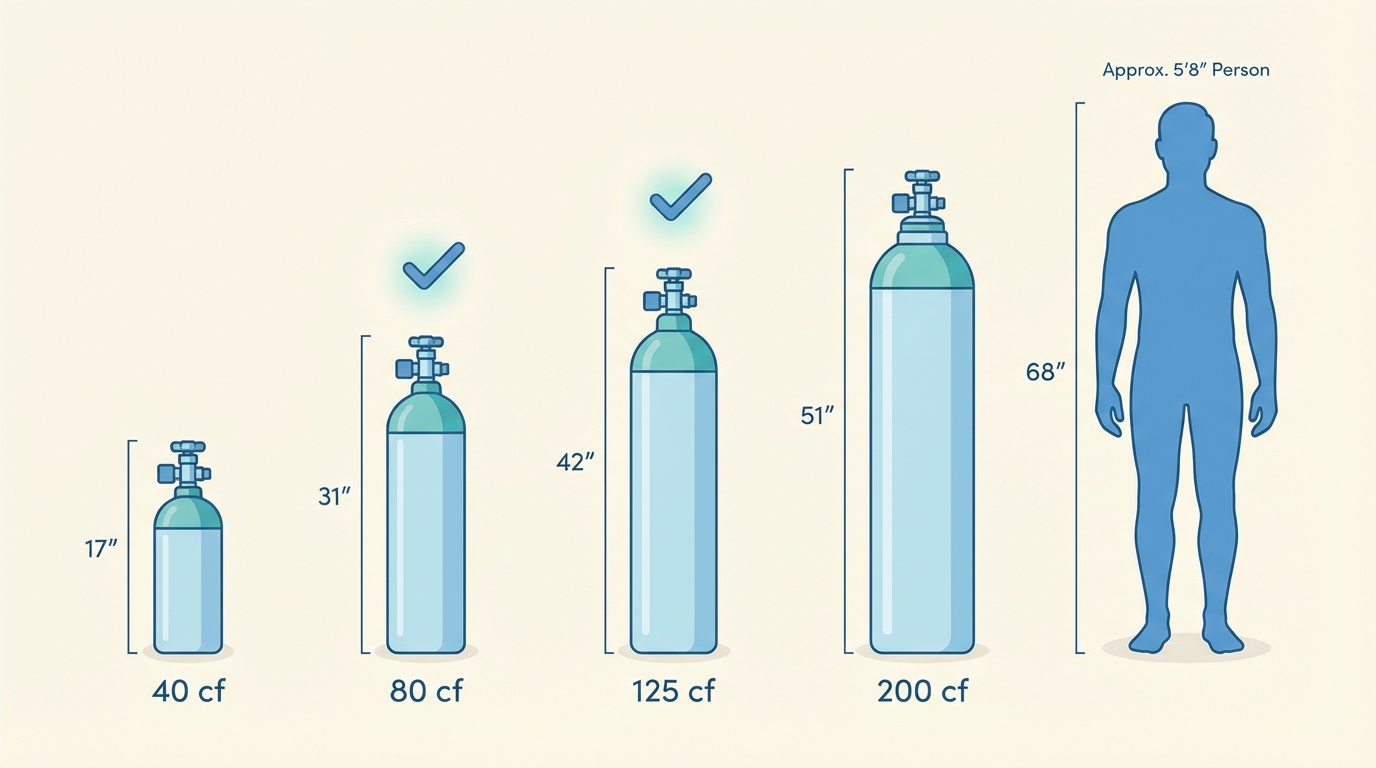 Cylinder size comparison. The 80 and 125 cf sizes are the most popular for home use. The 200 cf holds far more gas but requires a cart.
Step 3: Get a regulator, breathing equipment, and tubing
Regulators and fittings might differ between medical and welding oxygen. They are explained just below. Check the Equipment chapter for the rest of the walkthrough:
- Breathing equipment: demand valve, ClusterO2 kit, or non-rebreather mask.
- Assembly and testing: the 10-minute procedure to put it all together.
- Safety at home: the fire-safety rules that apply to any oxygen setup.
Regulator and fittings
Inlet. Your regulator's inlet must match the valve on your cylinder. In the US and Canada, all welding cylinder sizes use CGA 540 (a large threaded post). Outside North America, see the inlet table in Equipment § Regulators, fittings, and tubing and confirm with your supplier before buying.
Regulator type. As covered in the Equipment chapter, there are two regulator types: flow regulators (with a liter-per-minute (LPM) dial) and pressure regulators. Both are available in welding-grade versions. Welding pressure regulators have an adjustable output pressure, whereas medical pressure regulators output a constant pressure matched to a demand valve.
Option 1: Welding pressure regulator. Required if you use a demand valve, and also works with a ClusterO2 kit or non-rebreather mask (NRB): dial the output pressure up until the reservoir bag refills fast enough to keep up with your breathing (see Usage § Breathing techniques). Example models:
Your welding regulator might not come with the outlet you need:
- With a demand valve, the outlet has to mate with your demand-valve hose. In the US, that will often be a threaded DISS. Example barb-to-DISS adapter.
- With an NRB or ClusterO2 kit, the outlet has to be a barb for standard oxygen tubing.
Option 2: Flow regulator. A flow regulator with an LPM dial works with an NRB or ClusterO2 kit, but not with a demand valve (which needs a set inlet pressure). A common US choice is the Responsive Respiratory 25 LPM CGA 540 regulator.
Outside the US, ask your welding supplier or a local cluster-headache community for a regulator brand commonly used in your country with the appropriate connector.
Cost summary
Prices below are in USD and reflect the US market. Prices in other countries vary; use this table as a structure (rental + fills + one-time equipment) rather than as a direct guide to local costs.
| Item | Approximate cost | Notes |
|---|---|---|
| Cylinder rental (monthly) | $15–25/month | Or buy outright for $100–200+ |
| Cylinder fill | $20–40 per fill | Depends on size |
| Regulator (CGA 540) | $20–70 | One-time; welding style ~$20–30, medical LPM ~$30–70 |
| ClusterO2 kit | ~$32 | Or standard NRB for ~$5 |
| Demand valve (optional upgrade) | $250–400+ | Most efficient O₂ use |
| Oxygen tubing | ~$5 | Standard 7-foot (~2 m) |
| Cylinder cart or strap | $30–60 | One-time; optional but recommended |
| Total first month (mask) | ~$125–230 | With ClusterO2 kit or NRB |
| Total first month (demand valve) | ~$375–600+ | With demand valve |
| Ongoing monthly | ~$35–65 | Rental + 1 refill; heavy cycles cost more |
Compare: medical oxygen through a DME supplier without insurance often costs $200–400+ per month. During heavy cluster periods, you may need multiple refills per week, which can push ongoing welding oxygen costs above $100/month, still well below the medical route.
Tips from the community
At 25 LPM an 80 cf tank gives you about 90 minutes of total use. During heavy cluster periods you may need multiple refills per week, which is why bigger cylinders are worth the effort.
Set everything up before a cycle starts. Test the setup once, then keep it somewhere you can grab it the moment an attack starts.
The breathing equipment matters. In rough order of effectiveness: demand valve, then ClusterO2 kit, then NRB with side vents taped shut, then basic NRB. Upgrade when you can (see Equipment § Breathing equipment).
Check the setup every so often. Keep a spare regulator or mask if you can.
Wash the mask, mouthpiece, or demand valve in warm soapy water regularly so dirt does not build up. Swap used parts.
References (8)
- ↩ Rozen TD (2011). Inhaled oxygen and cluster headache sufferers in the United States: use, efficacy and economics: results from the United States Cluster Headache Survey. Headache, 51(4). Link
- ↩ Burman F (2022). Do I Need Medical Grade Oxygen?. Alert Diver. Link
- ↩ Mo H et al. (2022). Oxygen therapy for headache disorders: a comprehensive review. Pain Physician. Link
- ↩ ClusterBusters forum (2016). Welding Oxygen. ClusterBusters. Link
- ↩ ClusterBusters forum (2017). Welding Oxygen Usage Feedback. ClusterBusters. Link
- ↩ FDA (2024). Current Good Manufacturing Practice, Certification, Postmarketing Safety Reporting, and Labeling for Medical Gases. Federal Register. Link
- ↩ FDA (2016). Medical Gas Containers and Closures; Current Good Manufacturing Practice Requirements. Federal Register. Link
- ↩ Cluster Headache Warriors (2024). Welder's O2 — A Last Resort. Cluster Headache Warriors. Link
Did this guide teach you something you'll act on?
Disclaimer
The information on this website is provided for educational and harm reduction purposes only. It does not constitute medical advice and should not replace consultation with a qualified healthcare professional. See our Legal page for more details.