Preparing your dose
How to obtain, measure, and prepare a dose of psilocybin mushrooms, LSD, LSA seeds, or 5-MeO-DALT to prevent cluster headaches.

Written by Peter Skov-Andersen, MSc
This page covers how to actually obtain, measure, and prepare a dose of each substance. The good news is that for all four, the preparation is much simpler than for DMT. For LSD you mostly just cut a piece of paper. For LSA you grind a few seeds and soak them in water, with an optional extra step to make the dose more consistent and easier on the stomach. For 5-MeO-DALT you weigh some powder and put it in a capsule. Psilocybin needs a little more care, but it is also the substance you can most easily produce yourself, by growing mushrooms at home.
Psilocybin
What you need
- Dried psilocybin mushrooms (most commonly Psilocybe cubensis).
- A digital scale that reads to 0.01 g.
- Empty gelatin capsules (size 0 or 00) if you want to avoid the taste, plus a small funnel or capsule-filler.
- Time and a quiet place. Allow about 4–6 hours per dose, with no driving or work.
Sourcing
In most countries, buying ready-made psilocybin mushrooms is illegal and quality can vary. Many patients grow their own at home. It is straightforward, low-cost ($60–80 for the quickest and easiest grow setup), and gives you full control over freshness and potency. Spore syringes (which you need to start a grow) and grow kits are legal in many places where the mushrooms themselves are not, because spores do not contain psilocybin. Spores can be bought online from various vendors such as Lord of Spore, Inoculate the World, and SporesMD.
By far the simplest way, once you have the spore syringe, is acquiring an already sterilized block of substrate that you can inject the spores into. A good example is this one. From there, all you need to do is wipe things down with 70% isopropyl alcohol, inject the spores, and wait.
For long-term use, it can be financially beneficial to learn how to make your own substrate block. For a complete beginner, the following YouTube playlist walks through the entire process.
Psilocybin is best stored in an airtight jar in a dark room, slightly below room temperature.
Dose
A typical preventive dose is 0.5 grams. The goal is to feel only mild effects: some body warmth, a little relaxation, perhaps slightly altered perception. You should not be having a strong "trip". If 0.5 g feels too mild and the cycle is not breaking, you can go up to 0.75 g or 1 g on subsequent doses.
Potency varies between strains, between batches, and even between caps and stems of the same mushroom. Start at the lower end and adjust upward, not the other way around.
If you are using fresh psilocybin truffles (common in the Netherlands, where they are legal), the equivalent dose is roughly 10 grams of fresh truffles per 1 gram of dried mushrooms, since truffles contain less psilocybin by weight and are about 70% water. So a typical preventive starting dose is around 5 grams of fresh truffles, increasing to 7 to 10 grams if needed. Truffle potency varies between batches, so weigh carefully and start low.
How to take it
There are several common methods. They are roughly equally effective, so pick whichever you find easiest to swallow.
-
Eaten whole. The simplest method. Chew thoroughly. The taste is unpleasant. Take on a near-empty stomach for best absorption.
-
Tea. Finely chop or grind the mushrooms, soak in hot (not boiling) water for about 10 minutes, strain, drink. You can repeat the steep with fresh hot water and combine the liquids. Tea is sometimes gentler on the stomach. You can add ginger, lemon, or honey to mask the taste.
-
Capsules. Grind the dried mushrooms into a powder and pack into capsules. The most discreet method, and useful if the taste makes you nauseous. Effects come on a little slower than tea.
-
Lemon tek. Optional. Grind the mushrooms and soak them in fresh lemon juice for 20 minutes before drinking. The acid converts psilocybin to psilocin in advance, so the effects come on quicker, are stronger, and end sooner.
Take on a near-empty stomach. A heavy or fatty meal can blunt absorption.
LSD
What you need
- A blotter, liquid LSD, or microdots from a trusted source.
- An LSD testing kit (Ehrlich's reagent).
- Sharp scissors or a clean razor blade if you need to cut a blotter.
- Time and a quiet place. Allow about 6 to 8 hours per dose.
Sourcing
LSD is harder to source reliably than psilocybin. It cannot be grown at home. The main forms patients encounter are blotter paper (small printed squares soaked in LSD), liquid LSD (a dropper bottle), and microdots (tiny pressed pellets, less common today). Whichever form you obtain, you need to know the dose per unit, ideally from a source that has been independently tested. LSD blotter paper and microdots are best stored in the freezer to prevent degradation, and LSD liquid should be stored in the fridge if the bottle is made from glass to prevent it from breaking.
Testing
Occasionally, things sold as LSD are not actually LSD but other compounds that may or may not have the same safety profile. It is therefore highly recommended that you test your LSD. This is a very simple procedure. LSD testing kits usually consist of a bottle of a liquid substance called Ehrlich's reagent. Ehrlich's turns purple in the presence of a class of drugs called "indoles," which includes substances like LSD, psilocybin, DMT, and more. Simply cut off a small corner of your LSD tab and put a drop of Ehrlich's reagent on top (the provider will have more detailed instructions). If Ehrlich's does not turn purple, it means no LSD is present. Patients sometimes use mail-order testing services that confirm both purity and dose.
Dose
A typical preventive dose is 25 to 50 micrograms. To put that in perspective, a standard recreational dose is around 100 micrograms, and many blotter tabs are sold as 100 mcg. So one quarter to one half of a 100 mcg tab is a typical preventive dose. Always ask your provider for how much LSD is in your blotter paper, liquid, or microdot.
How to prepare it
-
Blotter paper. Use a sharp kitchen knife, scissors, or a clean razor blade. Cut the tab into equal pieces. For a 100 mcg tab cut into quarters, each quarter is roughly 25 mcg. Place the piece on or under your tongue and hold it there for 10 to 20 minutes; the LSD absorbs through the lining of your mouth. You can swallow the paper or spit it out.
-
Liquid LSD. Liquid is sold by drop, with a known number of micrograms per drop (e.g., 100 mcg per drop). To take a 25 mcg dose from a 100 mcg drop, you would need to dilute it. Many patients dilute liquid LSD into a known volume of distilled water in advance, allowing more precise small doses by drop or by dropper.
-
Microdots. Hard to split and less common. If you can find them, treat them like a tab and try to break them as evenly as possible.
Once you have your dose, simply place it in your mouth and let it dissolve, or swallow with water. Effects start in 30 to 90 minutes. Resist the urge to take more in the first hour; LSD ramps up slowly.
LSA
This section draws heavily on a guide (with video) written by David Nickerson, a cluster headache patient. We are grateful for his work.
What you need
For the basic method
- Seeds of Rivea corymbosa (ololiuqui) or Hawaiian baby woodrose (HBWR), bought untreated from a seed supplier.
- A pepper mill, spice or coffee grinder, or mortar and pestle.
- A small glass of water, plus citrus or cranberry juice as a chaser.
- A digital scale that reads to 0.01 g.
- Time and a quiet place. Allow a few hours per dose.
If you add the optional naphtha rinse
- Naphtha that evaporates clean (VM&P naphtha or Ronsonol lighter fluid).
- A glass jar with an airtight lid, coffee filters, paper towels, and aluminum foil.
- Gloves, and somewhere with fresh air and no flames.
Sourcing
All of these seeds come from the morning glory family (Convolvulaceae), which contains more than a thousand species, so "morning glory" on a seed packet is not specific enough to dose from. The two that patients use are:
- Rivea corymbosa, also written Turbina corymbosa or Ipomoea corymbosa, and sold as ololiuqui or "shaman's morning glory".
- Hawaiian baby woodrose (Argyreia nervosa), usually shortened to HBWR.
The ordinary garden morning glories Ipomoea tricolor and Ipomoea violacea, sold under names like "Heavenly Blue", are not recommended. Seed sold for the garden is frequently treated with fungicides, partly to discourage people from eating it. Always buy untreated seed, and do not use seed from a garden packet unless you know it is untreated.
Both Rivea corymbosa and Hawaiian baby woodrose are sold openly by garden and online seed vendors, because the plants are legal ornamentals and the seeds are sold for growing rather than eating.[1]
Seed potency varies a great deal between plants, harvests, and suppliers, so the strength of any given batch is never exactly known. Reports also suggest that the small "Hawaiian" strain of HBWR is considerably stronger than the larger Ghana and Indian strains, so it is worth knowing which you have.
Store seeds cool, dry, and out of the light. They keep well in the freezer.
Dose
LSA is unusual among the four substances in this guide: the dose is normally counted in seeds rather than weighed, because the amount of LSA in each seed varies. Start low and increase slowly.
- Rivea corymbosa (ololiuqui): a common starting point is 6 to 8 seeds, increasing or decreasing slowly until there is a noticeable but mild effect. Depending on potency, some patients have needed 40 seeds or more.[1]
- Hawaiian baby woodrose: the seeds are larger and stronger, so the starting point is lower, often 1 to 2 seeds, adjusting one seed at a time.[1]
Do not be tempted to jump ahead. In a published case report, a cluster headache patient who took six Hawaiian baby woodrose seeds at once had a full psychedelic experience along with stomach cramping severe enough that she went to hospital. You can always take more, never less.[2]
How much you actually need is better understood in terms of total alkaloids than seed count. In the largest patient survey of LSA-containing seeds, people who had taken roughly 1 mg or less of total alkaloids were non-responders, while those who benefited had taken a little more, and 93% of all users took a dose too small to produce any psychoactive effect at all.[3] That is the target you are aiming for: enough to work, too little to feel.
Weighing. As a rough guide, one Hawaiian baby woodrose seed is about 95 mg of ground seed, or about 85 mg after a naphtha rinse. These two figures are not interchangeable. Washed powder is slightly more concentrated by weight, so always know which one you are measuring.
How to prepare it: the basic method
- Grind the seeds to a rough powder using a pepper mill, spice grinder, or mortar and pestle. For Hawaiian baby woodrose, first pick the soft seed interior out of the tough outer hull and discard the hulls, which contain unfriendly chemicals. This is not strictly necessary but is recommended, and it is likely less important if you do the naphtha rinse.
- Soak the ground powder in a small amount of water for about an hour or more.
- Strain the liquid through a coffee filter and throw away the pulp. Some people swallow the whole slurry instead, but straining out the seed material is usually easier on the stomach.
- Drink it with a water or juice chaser. It is unpleasant, so swallow it quickly rather than sipping it.
Effects can be felt from about 20 minutes to 2 hours after drinking.
Getting a more consistent dose (recommended)
The biggest weakness of LSA is that the seeds vary. A survey that chemically analyzed patients' own seed samples found a ten-fold variation in alkaloid content between samples, and some seeds contained no alkaloids at all.[3] Counting seeds cannot correct for that.
There is a simple fix that costs nothing and adds no risk: grind a whole batch at once and weigh each dose out of it.
- Float-test the seeds first. Drop them into a glass of water. Good seeds sink; any that float are dried out and no longer of any use, so skim those off and throw them away.
- Count the seeds you have left and write the number down. You will need it to work out your doses.
- Let the seeds dry on a paper towel.
- Grind them together and mix the powder thoroughly.
- If you are doing the optional naphtha rinse, do it at this point, before you weigh anything.
- Weigh the batch and work out what one seed weighs (see below).
- Weigh out one dose at a time.
- Keep the rest in a light-proof container in the fridge or freezer.
Working out what one seed weighs
Once a batch is ground, you can no longer count seeds, so you need a way to translate weight back into seeds. It is worth doing, because knowing roughly how many seeds are in each dose is what lets you adjust up or down sensibly.
The math is one division, done once per batch:
- Count the seeds before you grind them, after discarding any floaters, and write the number down somewhere you will find it again.
- Weigh the whole finished batch after grinding, and after the optional naphtha rinse if you are doing one. Weigh it in the state you will actually be dosing from.
- Divide the batch weight by the number of seeds. That gives you the weight of one seed's worth of powder. Write this number down next to the first one.
- To take a dose, multiply. One seed's worth × the number of seeds you want.
A worked example. You float-test 100 seeds and throw away 6 floaters, leaving 94 seeds. You grind them, rinse them, dry them, and weigh the batch: 8,000 mg (8 g). 8,000 ÷ 94 = 85 mg per seed. So a 2-seed dose is 2 × 85 = 170 mg, and a 3-seed dose is 255 mg.
Keep both numbers with the jar, the seed count and the weight per seed. They only apply to that batch: the next batch of seeds will be a different strength, so work it out again from scratch each time and go back to a low starting dose.
Because every dose comes from the same well-mixed batch, a weak seed and a strong seed average each other out, and your doses become far more predictable from one to the next. You still have to find your own dose by starting low, but once you do, it stays put for that batch of seeds.
One caution: ground, unwashed seed still contains the seed oils, which go stale over time. Keep a ground batch frozen and dark, and use it within a few months. If you want to keep a batch longer than that, the optional rinse below removes the oils and makes the powder keep much better.
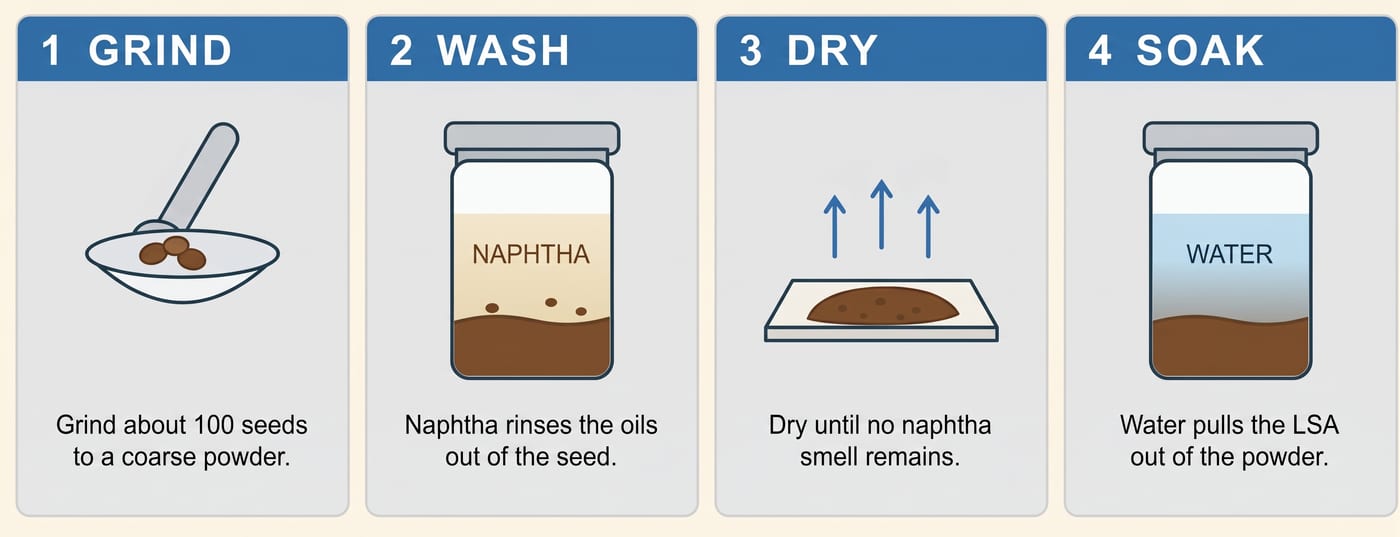
Optional: rinsing the powder with naphtha to reduce nausea
This is an extra step that some patients add between grinding and soaking. It is entirely optional. The basic method above works without it.
What it does. Naphtha dissolves the oils and fats in the seed, but LSA does not dissolve in naphtha, so the LSA stays behind in the seed material. In other words, the rinse cleans the seed. It is not what extracts the LSA: the water soak is still what pulls out your dose.
Why people do it. Patients and the wider psychedelic community widely report that washed powder is noticeably easier on the stomach. This has not been formally studied, and the reports consistently describe the nausea as reduced rather than removed. Some people notice little difference. A large part of LSA's nausea comes from the alkaloids themselves, which no washing step can take out. The second benefit is more certain: with the oils gone, a ground batch holds its strength for about a year in the freezer instead of a few months.
What it does not do. The rinse does not remove the other ergot compounds in the seed. Those dissolve in water rather than naphtha, so they come through into your drink exactly as they otherwise would. Everything in the safety chapter about ergot compounds, pregnancy, and heart or circulation problems applies to washed seed just the same.
A note on legality. Processing seeds into a stored, concentrated powder is treated more seriously than simply holding seeds in many places, and in some countries counts as manufacturing a controlled substance rather than possessing one. See the legality chapter before you decide.
Safety first. Naphtha is very flammable. Keep it away from any flame, spark, cigarette, or pilot light, work somewhere with fresh air or a ventilation hood, wear gloves, and never heat it. Use a naphtha that evaporates completely and cleanly: VM&P naphtha or Ronsonol lighter fluid are the usual choices. Do not use Zippo fluid or Coleman / white gas, which leave a residue behind. To test a solvent, let a few drops dry on clean glass. If it leaves any mark, smell, or oily film, do not use it.
The steps.
- Grind the seeds as above and put the powder in a glass jar.
- Add about three to four times the powder's volume of naphtha. Seal the jar, shake it, wrap it in foil to keep the light out, and leave it for at least an hour.
- Without shaking it again, pour off the naphtha, leaving the powder behind. Refill with fresh naphtha and wait another hour.
- Repeat once more, for three rinses in total.
- Pour the powder into a coffee filter, let it drip, then spread it out and dry it completely until there is no naphtha smell at all. Do not use it before then.
- Store the dried powder in a light-proof container in the freezer.
Dispose of the used naphtha by letting it evaporate from a shallow dish outdoors or by an open window, away from any flame. Never pour it down the drain.
Then carry on with the water soak in the basic method above.
5-MeO-DALT
What you need
- 5-MeO-DALT powder (freebase or HCl salt form), from a reputable supplier with published purity assays of >98%.
- A milligram scale that reads to 0.001 g (1 mg). Standard kitchen scales are not precise enough.
- Empty gelatin or vegetable capsules, size 4 or 5.
- A small spatula or weighing dish.
Sourcing
5-MeO-DALT is sold as a "research chemical" by various online suppliers. Quality varies widely. Stick to suppliers that publish independent lab assays for each batch, with purity above 98%. Many reputable suppliers ship internationally to countries where DALT is legal. (See the legality chapter.)
It comes in two forms: freebase (the pure compound, slightly off-white powder) and HCl salt (a hydrochloride form that dissolves in water). Both work the same. The HCl form is slightly easier to store and dissolve. The freebase form has a numbing taste if it touches your tongue, which is why patients put it in capsules.
Dose
The standard preventive dose is 15 mg orally. This is the dose used in the original 2014 case study and used by 74% of patients in the 2015 follow-up survey.[4] Most patients do not need to go higher. Some have used 25 mg or even 50 mg, but side effects (mostly cold extremities and dizziness) increase with little additional benefit.
If 15 mg feels too strong, you can start at 10 mg and work up. Do not start above 15 mg.
How to prepare it
Preparation is simple:
- Place an empty capsule on your scale and tare (zero) it.
- Carefully spoon 15 mg of powder into the capsule using a small spatula.
- Cap the capsule and swallow with water.
- If using the HCl form, you can alternatively dissolve 15 mg in a small amount of water and drink it. The numb taste is brief.
Effects begin within about 10 minutes and resolve within about 2 hours.
General tips
-
Storage. Keep all four substances cool, dry, and dark. Psilocybin and LSD both degrade over time when exposed to heat or light. Long-term storage for LSD is best in the freezer, in an airtight container. Do not put psilocybin mushrooms in the freezer as this will greatly decrease their potency — a study has found that dried mushrooms stored in a dark, airtight container at room temperature is the best way to keep the potency.[5] LSA seeds keep best cool, dry, and dark, and can be frozen for longer storage.[1]
-
Source verification. Whatever you obtain, knowing the dose matters a lot. With mushrooms, weigh dried material on a calibrated scale. With LSD, use tested products. With DALT, use suppliers that publish lab assays.
-
Set up your space in advance. Whichever substance you choose, prepare your space before taking the dose. A comfortable chair, water, a snack for later, your headache log, and a phone within reach. You should not have to do anything complicated once the dose has kicked in. Listening to music is an excellent way to pass the time while you wait for the effects to be over.
References (5)
- ↩ Clusterbusters (2024). LSA – Seeds of the Vine. Clusterbusters. Link
- ↩ Johnson S, Black QC (2020). Can psychedelics alleviate symptoms of cluster headache and accompanying mental health problems? A case report involving Hawaiian baby woodrose. Journal of Psychoactive Drugs, 52(4), 319–323. doi:10.1080/02791072.2020.1762023
- ↩ Sewell RA, Reed K, Cunningham M (2008). Response of cluster headache to self-administration of seeds containing lysergic acid amide (LSA). Poster presented at the American Headache Society 50th Annual Scientific Meeting.
- ↩ Post M (2015). Cluster headache patient survey: 5-MeO-DALT. Self-published.
- ↩ Gotvaldová K, Hájková K, Borovička J, Jurok R, Cihlářová P, Kuchař M (2021). Stability of psilocybin and its four analogs in the biomass of the psychotropic mushroom Psilocybe cubensis. Drug Testing and Analysis, 13(2), 439–446. doi:10.1002/dta.2950
Did this guide teach you something you'll act on?
Disclaimer
The information on this website is provided for educational and harm reduction purposes only. It does not constitute medical advice and should not replace consultation with a qualified healthcare professional. See our Legal page for more details.