Abortar ataques de cefalea en racimos con oxígeno de alto flujo
Una guía completa sobre cómo usar oxígeno de alto flujo para abortar ataques de cefalea en racimos: cómo funciona, cómo usarlo correctaments y cómo conseguirlo.

Escrito por Nicolas Macé, PhD
Oxígeno: el tratamiento legal de referencia
El oxígeno de alto flujo es el tratamiento legal más seguro para abortar ataques de cefalea en racimos. En estudios clínicos controlados, aproximadamente cuatro de cada cinco pacientes que responden al tratamiento detienen un ataque en menos de 15 minutos, sin efectos secundarios ni ataques de rebote.[1] El oxígeno es reconocido como tratamiento agudo de primera línea por la European Academy of Neurology (EAN).[2]
El oxígeno es inusual entre los tratamientos médicos: la rapidez con la que actúa, e incluso si actúa o no, depende mucho de cómo lo usas. Encontrar el equipo y la técnica correcta puede ser difícil. Esta guía existe para explicarte cómo usarlo.
Quienes llevamos aquí mucho tiempo hemos aprendido que cuando alguien dice que probó el oxígeno y no le funcionó, es muy, muy probable que su uso de oxígeno no haya sido óptimo, y puede que valga mucho la pena volver a intentarlo. […] Muchísima gente que pensaba que el O2 no le funcionaba ha descubierto que funciona bien cuando se usa correctamente.
— CHfather, moderador veterano del foro de ClusterBusters
En resumen: los mejores equipos y técnicas con oxígeno
Pero en todo caso, necesitarás un cilindro de oxígeno puro presurizado. Después, hay dos configuraciones de equipo que se sabe que funcionan bien, cada una con su propia técnica de respiración:
| Configuración | Pros y contras | Técnica de respiración |
|---|---|---|
| Equipo con válvula de demanda | Una válvula de demanda libera oxígeno bajo demanda (tan rápido como puedas respirar), lo que la convierte en la forma más rápida de abortar un ataque con oxígeno. Puede ser más difícil de conseguir con receta y más cara que la alternativa. | Hiperventílate con oxígeno puro: inhala a fondo, exhala a fondo, repite tan rápido como puedas. |
| Mascarilla con reservorio con un regulador de flujo suficientemente alto (explicado abajo). | Funciona bien para la mayoría de la gente, siempre que tengas el regulador adecuado (se recomiendan 25 litros por minuto o más) y una buena técnica de respiración. Suele ser más fácil de conseguir con receta que una válvula de demanda. Con flujo suficiente, aborta ataques casi tan rápido como una válvula de demanda; con flujo más bajo, la pausa para que se rellene la bolsa entre respiraciones puede hacer que actúe algo más despacio. | Respiración profunda y forzada: vacía los pulmones y luego inhala profundamente oxígeno puro. Repite tan rápido como la bolsa reservorio pueda mantener el ritmo. Haz pausa entre respiraciones solo si la bolsa no se ha rellenado. |
Un regulador es la pieza que se conecta al cilindro de oxígeno y controla cuánto oxígeno sale, medido en litros por minuto (LPM).
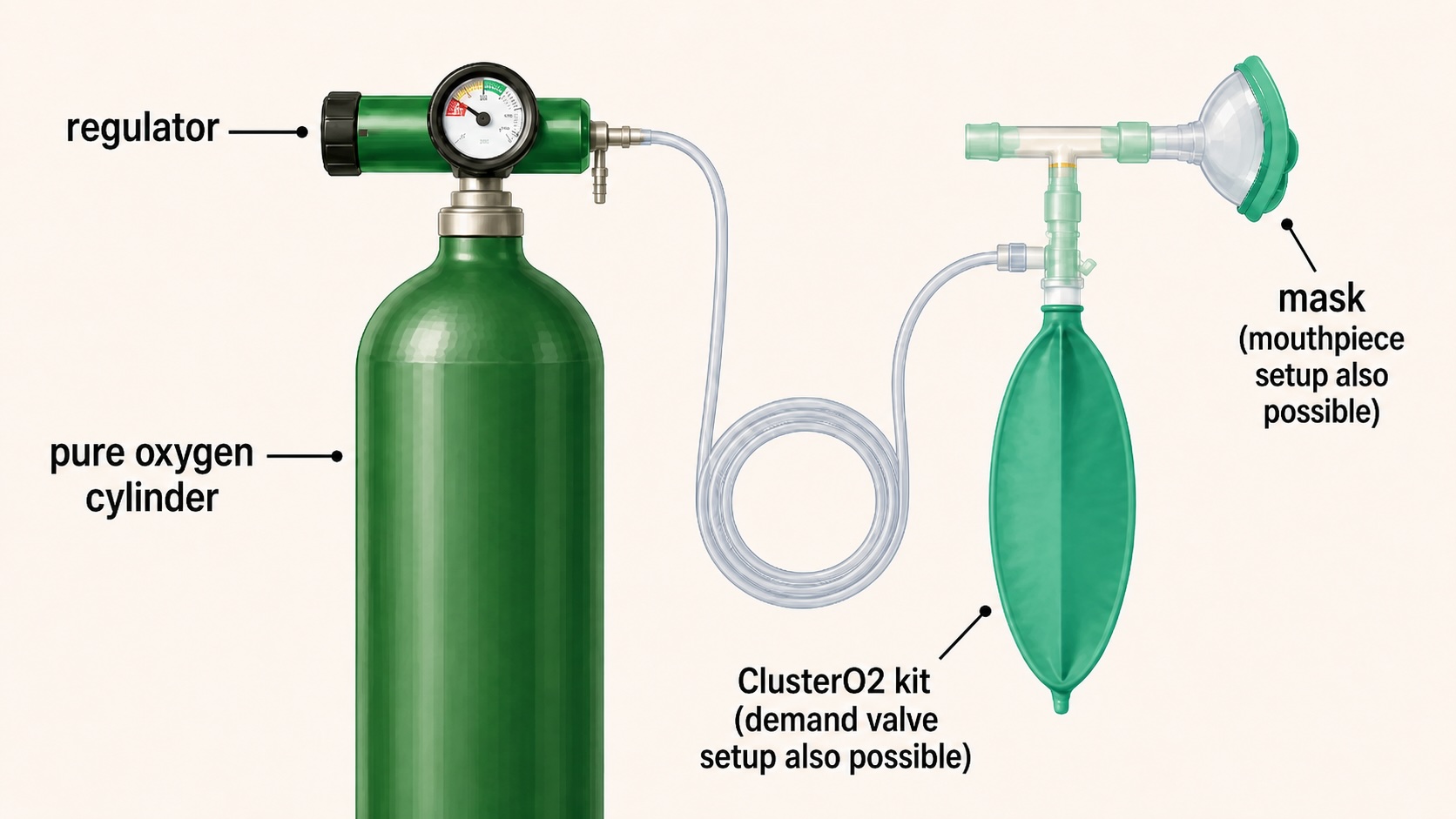
Las dos configuraciones y técnicas de respiración que funcionan
Equipo con válvula de demanda
Una válvula de demanda entrega oxígeno solo cuando inhalas, y puede mantener el ritmo incluso con una respiración muy rápida.
La técnica de respiración. Con una válvula de demanda, hiperventilas con oxígeno puro: inhala a fondo, exhala a fondo y repite tan rápido como puedas. Esto se considera ampliamente la forma más rápida y fácil de abortar un ataque de cefalea en racimos con oxígeno. En un ensayo aleatorizado cruzado, la válvula de demanda redujo aproximadamente a la mitad la necesidad de medicamento de rescate comparada con una mascarilla estándar, y la mayoría de los pacientes la prefirieron.[3]
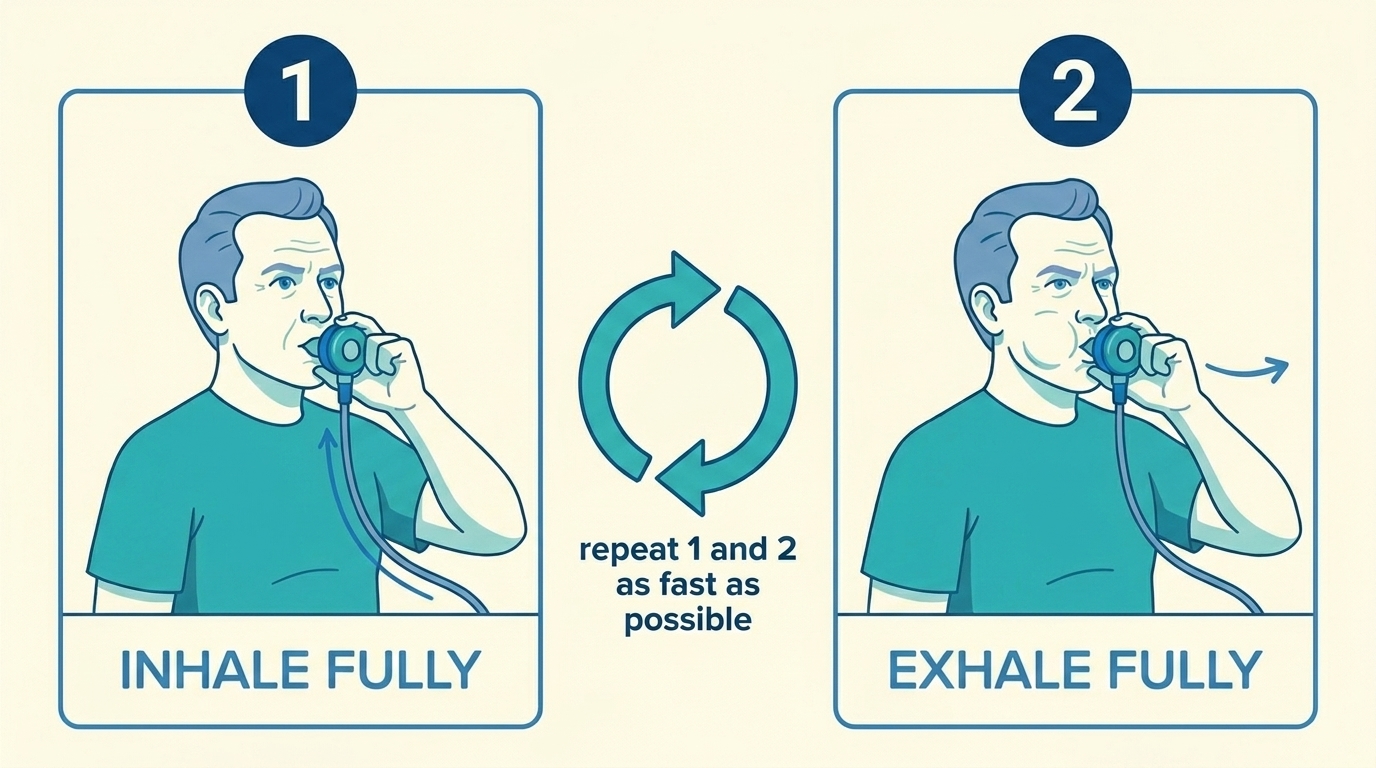 Técnica con válvula de demanda: inhala a fondo, exhala a fondo, repite tan rápido como puedas.
Video de demostración de la técnica de hiperventilación con una válvula de demanda.
El equipo. Una válvula de demanda normalmente requiere un regulador de presión. Esto es distinto de un regulador de flujo estándar (también llamado regulador LPM) que se usa con mascarillas con reservorio. Y las válvulas de demanda en sí son caras, lo que significa que pueden ser más difíciles de conseguir con receta. Por esta razón, algunos pacientes se saltan la vía de la receta por completo y compran oxígeno y equipo directamente con proveedores de soldadura. Consulta nuestra guía de oxígeno de soldadura.
Equipo con bolsa reservorio: kit ClusterO2 o mascarilla con reservorio
Un kit ClusterO2 o una mascarilla con reservorio estándar usa una bolsa reservorio. El oxígeno fluye hacia la bolsa de forma continua y tú respiras de la bolsa a través de una mascarilla o de una boquilla. Esta configuración funciona bien para la mayoría de la gente, y suele ser más fácil de conseguir con receta que una válvula de demanda. Sin embargo, la bolsa contiene una reserva limitada de oxígeno puro: si respiras más rápido de lo que el regulador puede rellenarla, la bolsa se vacía y tienes que esperar a que vuelva a llenarse. Por eso es importante conseguir un regulador con el LPM más alto posible.
La técnica de respiración. Vacía tus pulmones tan fuerte como puedas, y luego inhala profundamente, llenando los pulmones de oxígeno puro. El ritmo depende de tu flujo. Si la bolsa reservorio se mantiene llena entre respiraciones, respira tan rápido como puedas, al mismo ritmo que con una válvula de demanda. Si la bolsa empieza a quedarse baja, haz una breve pausa entre respiraciones para darle tiempo de rellenarse.
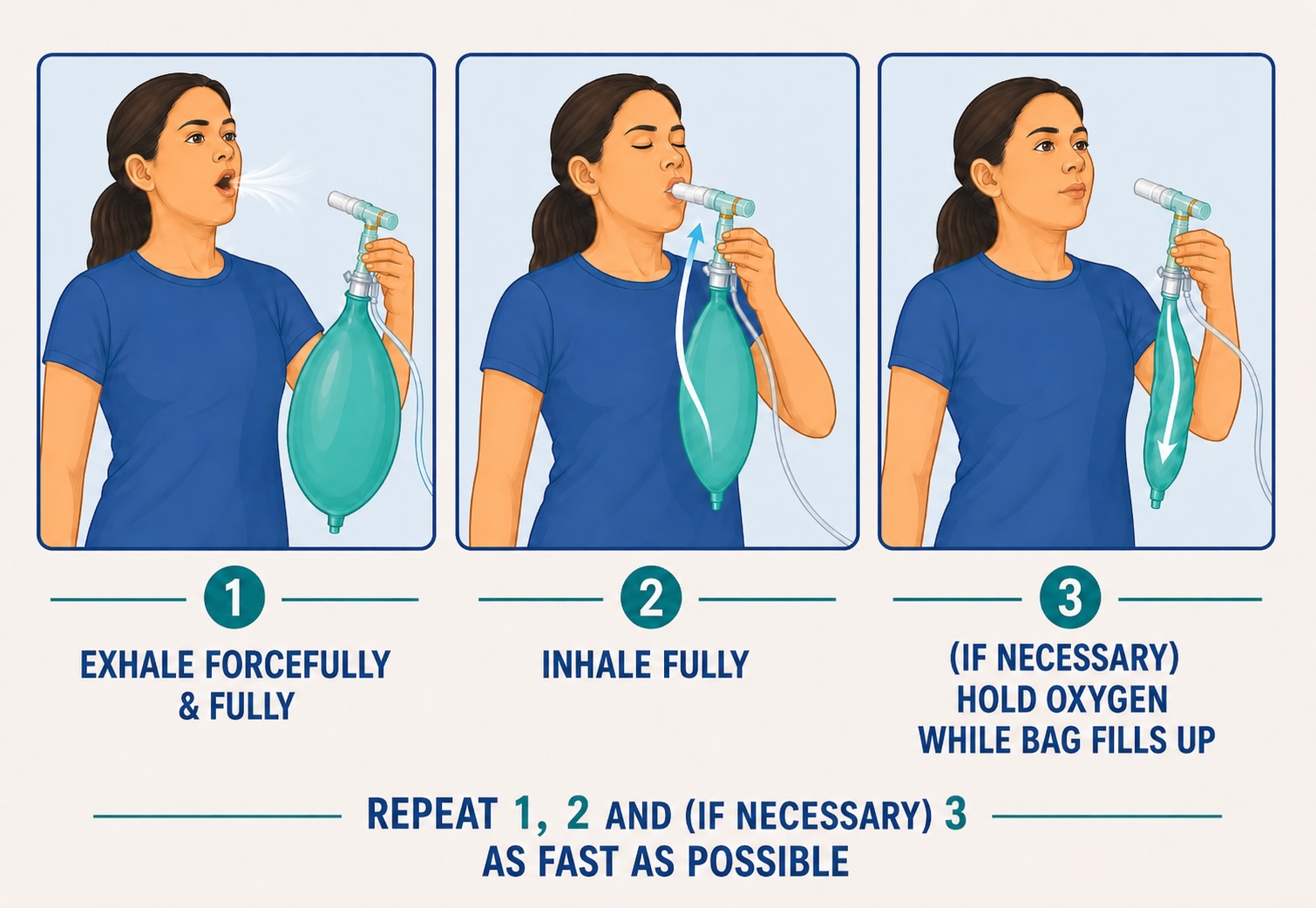 Técnica de respiración profunda: exhala completamente, inhala oxígeno puro, repite en cuanto la bolsa se rellene.
Video de demostración de la técnica de respiración profunda con un kit ClusterO2.
El equipo. La decisión más importante es el regulador. Se recomienda al menos 25 LPM. Los reguladores que entregan 40 LPM suelen estar disponibles y son baratos, y con ese flujo el equipo puede abortar ataques casi tan rápido como una válvula de demanda (a costa de usar más oxígeno por ataque). El flujo adecuado varía de una persona a otra; lo ajustarás a medida que vayas refinando tu técnica. Consulta Abortar un ataque con oxígeno para saber cómo.
Qué evitar
Para abortar un ataque, el gas que respiras tiene que ser oxígeno puro, sin diluir. Eso significa que hay tres cosas a evitar:
- Concentradores de oxígeno. Producen oxígeno con menor pureza y a un flujo demasiado bajo para abortar ataques de cefalea en racimos. El gas de origen tiene que venir de un cilindro de oxígeno puro.
- Cánulas nasales y mascarillas con orificios laterales abiertos. Permiten que el aire ambiente se mezcle con el oxígeno que inhalas. Si la mascarilla con reservorio que te han recetado tiene orificios laterales, puedes taparlos. Consulta el capítulo de Equipo.
- Mascarillas sin bolsa reservorio (mascarillas faciales simples). Sin una bolsa que mantenga una reserva de oxígeno puro entre respiraciones, la mascarilla no puede entregar suficiente oxígeno en la inhalación para llenar por completo tus pulmones.
Referencias (3)
- ↩ Cohen AS, Burns B, Goadsby PJ (2009). High-flow oxygen for treatment of cluster headache: a randomized trial. JAMA, 302(22), 2451–2457. Link
- ↩ May A, Evers S, Goadsby PJ, Leone M, Manzoni GC, Pascual J, et al. (2023). European Academy of Neurology guidelines on the treatment of cluster headache. European Journal of Neurology, 30(10), 2955–2979. doi:10.1111/ene.15956
- ↩ Petersen AS, Barloese MCJ, Lund NLT, Jensen RH (2017). Oxygen therapy for cluster headache. A mask comparison trial. A single-blinded, placebo-controlled, crossover study. Cephalalgia, 37(3), 214–224. doi:10.1177/0333102416637817
¿Esta guía te ha enseñado algo que vayas a poner en práctica?
Capítulos
- 1. Abortar un ataque con oxígenoCómo usar el oxígeno de alto flujo durante un ataque de cefalea en racimos. Usado correctamente, termina con el dolor en cuestión de minutos para la mayoría de los pacientes. Cuando no funciona, lo habitual es que el problema sea el equipo, el flujo o la técnica de respiración, y todo eso tiene solución.
- 2. EquipoEquipo de oxígeno para cefaleas en racimo: qué hace cada pieza del equipo y cómo elegirlas y ensamblarlas.
- 3. Cómo conseguir acceso al oxígenoCómo conseguir que te receten, te entreguen y te cubran el oxígeno a domicilio, con tácticas de escalada y alternativas para cada parte del proceso.
- 4. Oxígeno de soldadura: una vía más barata y sin recetaCuando no puedes conseguir oxígeno medicinal para abortar los ataques de cefalea en racimos: qué es el oxígeno de soldadura, por qué es seguro y cómo conseguirlo.
- 5. Preguntas frecuentesRespuestas breves a las preguntas que los pacientes hacen con más frecuencia sobre la oxigenoterapia para la cefalea en racimos. La cobertura más profunda de cada tema está en la subpágina correspondiente; se incluyen enlaces a lo largo del texto.
Descargo de Responsabilidad
La información en este sitio web se proporciona únicamente con fines educativos y de reducción de daños. No constituye asesoramiento médico y no debe reemplazar la consulta con un profesional de salud calificado. Consulte nuestra página de Aviso Legal para más detalles.