Extracting your own DMT at home
Everything you need to know to safely extract DMT at home, in order to abort cluster headache attacks.

Written by Nicolas Macé, PhD
DMT occurs naturally in certain plants. You can extract it yourself at home, using simple chemistry. This page covers extraction from the root bark of the Mimosa Hostilis tree (often sold as "MHRB" or "Mimosa Hostilis Root Bark"). The bark is available online. It's often sold as a natural dye. Legal status varies. Check your local laws before purchasing.
What to expect: The process takes about a day from start to finish. Most of that is waiting (cooling, freezing), with roughly 2–3 hours of active work spread across the day. It's simple kitchen chemistry: you don't need a lab, a chemistry degree, or any special skills.
If you've never worked with chemicals like lye and solvents before, it's completely normal to feel nervous. That's actually a good thing. It means you'll be careful. These chemicals are used routinely in homes for soap-making and cleaning. As long as you follow the safety steps below, the risk is very low.
What you'll end up with: Roughly 0.5–1.5 grams of DMT powder from 125g of bark, depending on bark quality and extraction efficiency. First-time yields are often on the lower end. With a 1g DMT per 3ml vape liquid, that's roughly enough to fill 1–5 standard (1ml) cartridges. These figures assume the default 125g batch. See Ingredient quantities below to scale the recipe to your batch. Once you have the powder, head to Preparing Your DMT Vape Pen to turn it into a vape.
Before you start: safety
This process involves two chemicals that require caution: lye (sodium hydroxide) which is caustic (can burn you) and an organic solvent (such as heptane) which is flammable. Neither is dangerous if you handle them sensibly, but ignoring the precautions below can result in chemical burns or a fire.
- Lye burns skin and eyes on contact. It may not immediately be painful, but can deeply penetrate tissues over time.
- If lye gets on your skin: immediately flush with lukewarm running water. Remove any clothing that's been exposed to the lye, and continue washing with water for at least 15 minutes.
- If lye gets in your eye: immediately flush with lukewarm running water. Remove contact lenses if wearing them, and continue washing. Hold your eyelids open and roll your eye so that water reaches every part of the eye and under the lid. Call emergency services. (See also: Mayo Clinic: eye emergency first aid)
- Lye reacts strongly with water. When lye is added to water, the mixture will get very hot and will release fumes.
- Always add lye to water, not the other way around. This ensures the reaction happens gradually.
- Use a heat resistant glass vessel (to avoid bursting), ideally with a narrow opening (to avoid lye splashing around). A heat-resistant Erlenmeyer flask (a cone-shaped flask with a narrow neck) is recommended.
- Lye solution emits toxic fumes for a few moments that you should avoid inhaling. Work in a well-ventilated space.
- Wear gloves and eye protection when handling lye. Rubber dishwashing gloves work. For eye protection, sealed chemical splash goggles (the kind that sit flush against your face) are strongly recommended. Lye can splash around the edges of regular safety glasses and cause permanent eye damage. These cost about $5–10 at hardware stores.
- The organic solvent is flammable. You should have no open flames or sparks near your workspace while the solvent is open or drying.
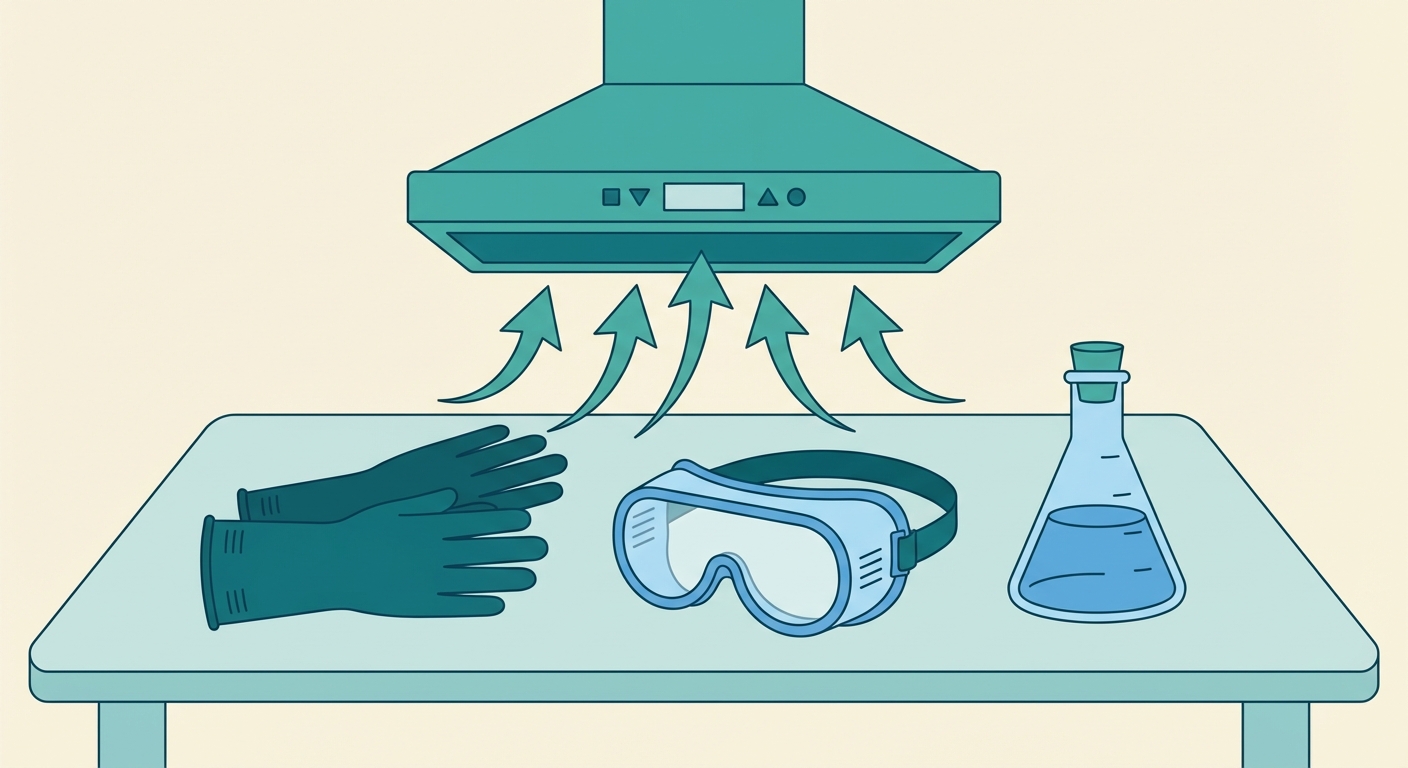 Before you begin: Make sure you have gloves, splash goggles, a heat-resistant glass vessel, and work in a well-ventilated space.
Shopping list
You need about ten items. Most are standard household or laboratory supplies available online or at hardware stores.
| Item | What to look for | Notes |
|---|---|---|
| Mimosa Hostilis Root Bark (MHRB) | 125 grams or more. You can buy it as a fine powder (ready to be used) or shredded. | Sold online, often as a textile dye. If you buy shredded bark, you will need to grind it, for instance with a coffee grinder. Legal warning: MHRB can legally be sold in certain countries, such as the Netherlands. However, it might be illegal to import it. |
| Sodium hydroxide (NaOH) | 99%+ purity, 1 kg bag | Also called "lye" or "caustic soda." Sometimes sold as drain cleaner. Make sure it's pure NaOH with no additives. Search for "sodium hydroxide" at soap-making suppliers or Amazon. |
| Solvent | 1 liter bottle, ideally pure n-heptane. | N-heptane can be hard to find or expensive. See Choosing a solvent below for alternatives. |
| Salt | 30 grams salt. | You want salt without iodine or additives. Rock, pickling or kosher salt works. |
| Heat-resistant glass vessel with narrow opening | Erlenmeyer flask (1L) or borosilicate glass bottle | An Erlenmeyer is a cone-shaped flask with a narrow neck. The narrow opening prevents lye from splashing. Must be heat-resistant (borosilicate) glass: the type used in Pyrex and lab equipment. Search "Erlenmeyer flask" or "borosilicate flask" on Amazon. |
| Second glass vessel (sealable) | Erlenmeyer flask (1L) with stopper, or a large glass jar with lid | This is where the main extraction happens. The lid should not be metallic, as some metals react with the lye. You'll need to turn it upside down during mixing. A large mason jar works well. A narrow neck (e.g. an Erlenmeyer) will make pipetting easier. |
| Glass pipette | 20 ml capacity | For transferring the solvent layer. Search "glass pipette 20ml" online. |
| Flat glass dish with a sealing lid | Pyrex baking dish with a clamp-down or snap-on lid. | For crystallizing. Needs to fit in your freezer. Pick a large dish. The lid has to seal properly to minimize the risk of solvent fumes contaminating food and the ice in your freezer. |
| Glass funnel | Any size that fits your vessels | For adding the bark into the vessel, and for pouring the lye onto the bark. |
| Glass stirring rod | — | You can also use a spare glass pipette for stirring. |
| Kitchen scale | Reads in grams (1g precision is fine) | For measuring bark, NaOH, and salt. Any digital kitchen scale works, but note that you'll need a precision scale (0.01 gram precision) to add DMT to your vape. |
| Measuring cup or graduated cylinder | — | For measuring water and solvent. A standard kitchen measuring cup works (1 cup ≈ 240 ml). You can also measure liquids with the scale (1 g ≈ 1 ml). |
Choosing a solvent
You can pick pure n-heptane, or other solvents that meet three criteria:
- Non-polar: this just means it'll dissolve DMT and won't mix with water (just like oil).
- Evaporates at room temperature: its boiling point should be below 100°C.
- Not toxic: avoid hexane, which is a neurotoxin. Always research the toxicity of the solvent you buy.
Where to find it: pure n-heptane is most easily found online. If you can't find it or prefer a cheaper alternative, you can simply walk into any hardware or DIY store and look in the cleaning-solvent or paint-thinner aisle. Read the chemical composition on the label and pick a product whose ingredients are dominated by light alkanes: names like heptane, octane, or descriptions like "aliphatic hydrocarbons C6–C8". Make sure none of the ingredients are polar: that is, make sure none of them contain oxygen atoms.
You'll also need (from around the house)
- A freezer with space for the glass dish
- Cold water (tap is fine)
- A bottle of vinegar (for neutralizing the base mixture during cleanup. See Disposal section)
- Rubber gloves and sealed chemical splash goggles
- A razor blade (to scrape DMT crystals)
- pH test strips (for verifying neutralization during cleanup. Available at pharmacies or pet stores for ~$5)
Ingredient quantities
Use this calculator to scale the recipe to your batch. Quantities used in the rest of the chapter will automatically be adjusted accordingly.
Adjust the MHRB amount to scale every quantity for your batch. Numbers throughout this guide will update to match.
- NaOH (lye)
- 110 g
- Water
- 750–800 ml
- Salt
- 30 g
- Solvent (per pull)
- 120 ml× 3 pulls minimum
- Estimated DMT yield
- 0.5–1.5 g
- Approx. vape cartridges (1 ml each)
- 1–5
Times, temperatures, and the number of pulls don't change with batch size.
Overview: what you're doing and why
Here's what's actually happening in plain language. Understanding the logic makes the whole process less mysterious.
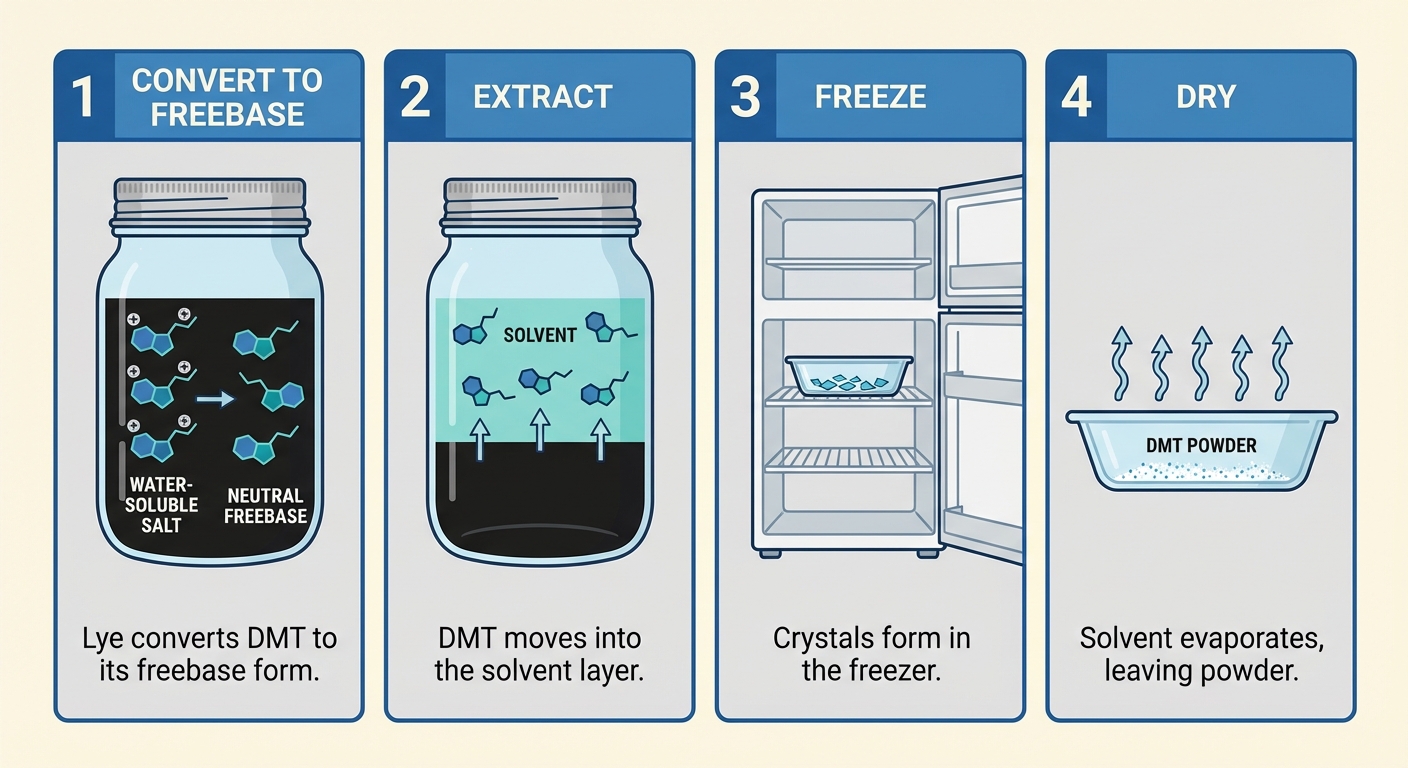 The four stages of extraction: convert the DMT to freebase, pull it into solvent, freeze to crystallize, and dry.
Here is a simplified overview of the steps (keep reading for more details):
-
Convert the DMT to freebase. Inside the bark, DMT is in a form that dissolves in water but not in solvent. The lye (a strong base) converts it into its "freebase" form: that's just the form that dissolves well in our solvent and in vape liquid. The lye also helps break down the bark, releasing more DMT into the solution. You don't need to understand the chemistry; just know that this step converts the DMT into the right form for vaping.
-
Pull the DMT into solvent. You add a non-polar solvent (such as n-heptane) on top of the lye mixture and gently turn the vessel upside down and back a couple times. "Non-polar" just means the solvent doesn't mix with water (just like oil). But DMT does dissolve in the solvent. So the DMT migrates out of the watery mixture and into the solvent layer floating on top.
-
Transfer and freeze the solvent. Using a pipette, you transfer the solvent loaded with DMT onto a glass dish. At this stage, you should be careful not to transfer any of the lye. When you put the solvent in the freezer, the DMT can no longer stay dissolved. It crystallizes out as a white or yellowish solid on the bottom of the dish.
-
Dry the crystals. You pour off the solvent and let the remaining liquid evaporate. What's left is DMT freebase powder.
Step-by-step protocol
Step 1: Prepare the bark
If your MHRB is not a fine powder already, shred or crush it as small as you can. Aim for pieces about the size of coffee grounds or smaller. A coffee grinder, blender, or herb grinder works well. Don't worry about getting it perfectly homogeneous. Some fiber and small chunks are completely normal. They'll break down further once they're in the lye solution.
Weigh out 125 g of finely ground MHRB.
Step 2: Prepare the salty lye
Time needed: About 15 minutes of active work, then several hours of cooling.
This step creates the lye solution that will convert the DMT into the freebase form: the form that dissolves in our solvent.
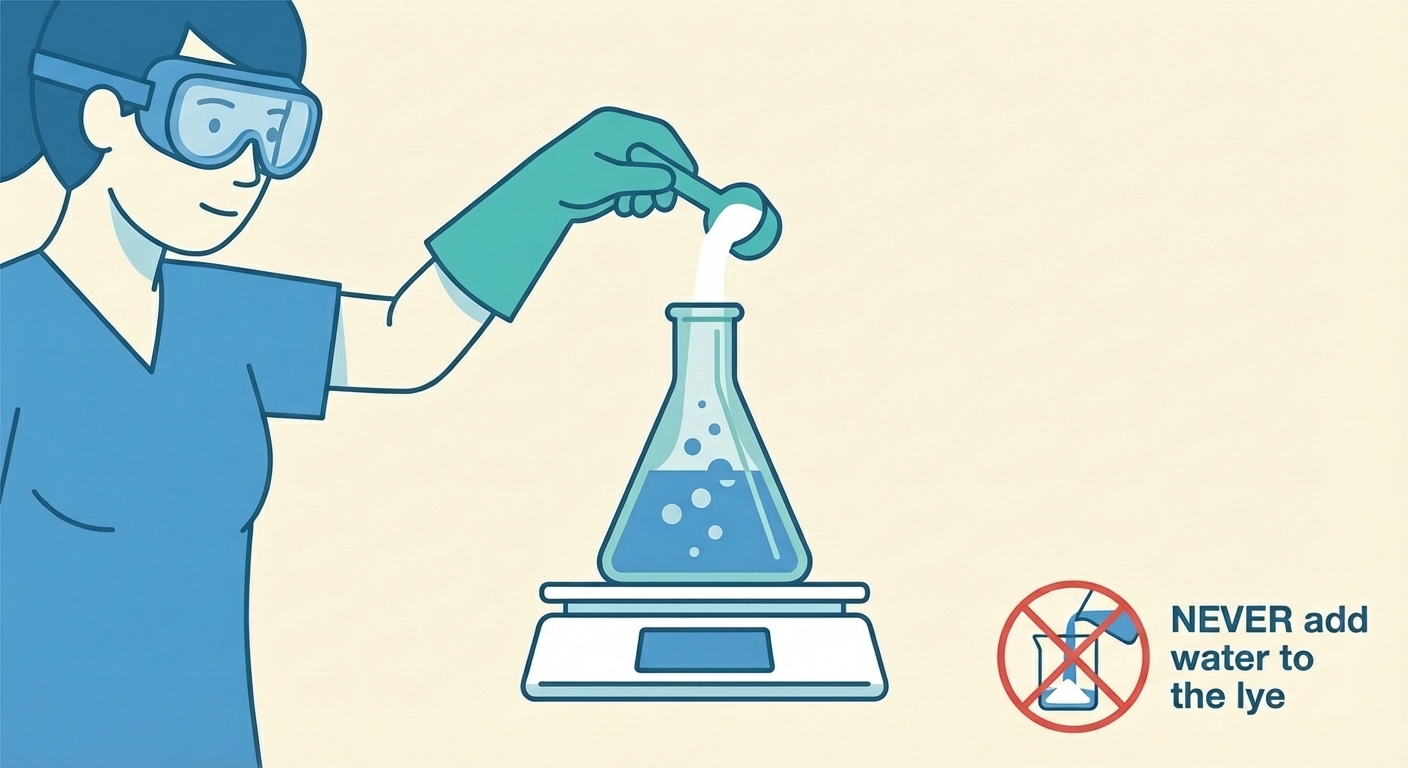 Add the NaOH to the water in small scoops. Never add water to NaOH: That can cause a violent, spattering reaction.
-
Safety first. Put on your gloves and splash goggles. Make sure the space you work in is well-ventilated: if you have an extractor hood, turn it on. Keep pets and children away.
-
Measure 110 g of NaOH in a glass vessel (a drinking glass works).
-
Fill your heat-resistant vessel with 750–800 ml of cold water. Tap water is fine.
-
Add the NaOH to the water, one level tablespoon at a time. Stir gently between each scoop and wait until the water looks transparent again before adding the next one (usually 30 seconds to a minute).
Dissolving NaOH in water generates a lot of heat. If you dump it all in at once, the solution can get dangerously hot (above 50°C), hot enough to crack your glass and splash caustic liquid. One tablespoon at a time keeps the temperature manageable.
The dissolution will emit toxic fumes, that you should avoid inhaling. Don't breathe too close to the flask.
-
Add 30 g of salt and stir until dissolved. Use salt without iodine and ideally as little additives as possible. Rock salt, pickling salt or kosher salt are good choices. Salt will help prevent an emulsion from forming (explained later).
-
Let the solution cool to room temperature, meaning that the side of the vessel shouldn't feel warm to the touch. This typically takes 2–4 hours. Don't rush it. If the lye is still hot when you add the bark, it can make the extraction messier (more plant fats dissolving into your final product). If you see some solid at the bottom of the vessel, give the liquid a stir (without splashing it around). If you don't have a glass stirring rod, use your glass pipette. Wash it thoroughly under running tap water once you're done.
Step 3: Combine bark and lye
Now you combine the bark with the lye solution. The lye converts the DMT into its freebase form and helps break down the bark.
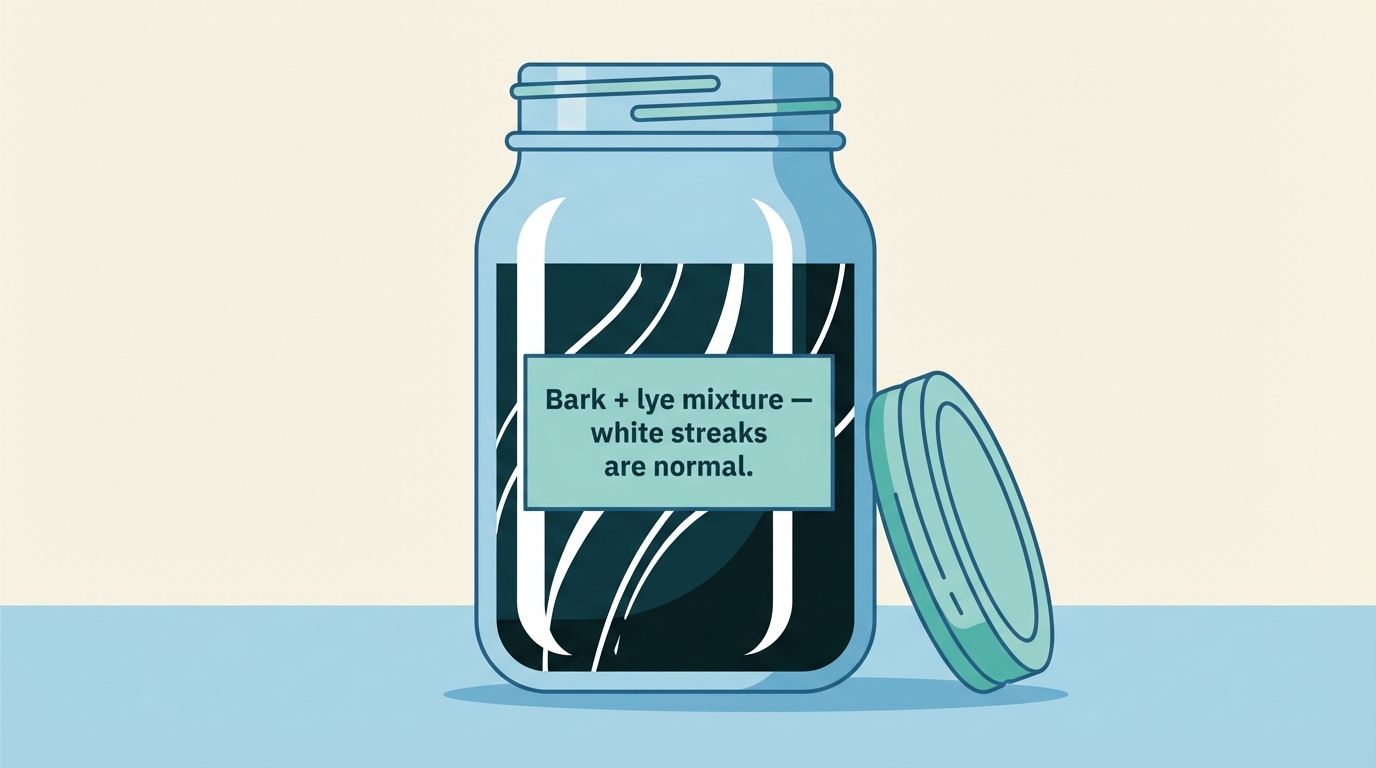 After mixing, the solution turns dark black. White streaks are normal and indicate the lye is reacting with the plant material.
-
Safety first. Continue wearing gloves and splash goggles, as you will handle the corrosive lye solution.
-
Add the MHRB powder to your second vessel (the sealable one).
-
Pour the salty lye over the bark. Be careful not to splash it, as it's corrosive. A glass funnel helps pour it.
-
Stir gently but thoroughly for 2 minutes. The mixture will turn very dark, almost black. You may see white streaks or lines forming. This is normal and means the lye is reacting with the plant material.
-
Let it sit for 10 minutes. If any dry bark floats to the surface, push it back down.
-
Stir again for 2 minutes.
-
Let it rest for another 10 minutes.
The bark is now fully treated. The DMT is in its freebase form, ready to be picked up by the solvent.
Step 4: Add solvent and mix
This is where you pull the DMT out of the base mixture and into the solvent. You'll be working in the same vessel from Step 3 (the sealable one with the bark and lye in it).
-
Safety first. You will be handling a flammable solvent which can emit fumes. Make sure there is no open fire or sparks anywhere near your workspace, and work in a well-ventilated space.
-
Add 120 ml of heptane or your chosen solvent to the vessel. It will float on top of the dark base mixture as a clear layer.
-
Seal the vessel tightly (screw on the lid, insert the stopper, or cork it). Before inverting, check the seal: flip it briefly over a sink to make sure nothing leaks. Then turn it upside down and back about 10 times. A gentle shake is also fine. The goal is to bring the solvent into contact with the base mixture so the DMT can migrate into the solvent.
If you happen to get a cloudy mess (called an "emulsion"), let it rest. If it won't separate back into two clean layers after an hour of waiting, here are things you can do to break it:
- Add more salt to the solution, give it a gentle shake, and wait.
- Place the vessel into a warm (not boiling) water bath. This speeds up the breaking process. Be careful, as this may release toxic fumes from your solvent.
- Add a little bit of lye (the solid), give it a gentle shake, and wait.
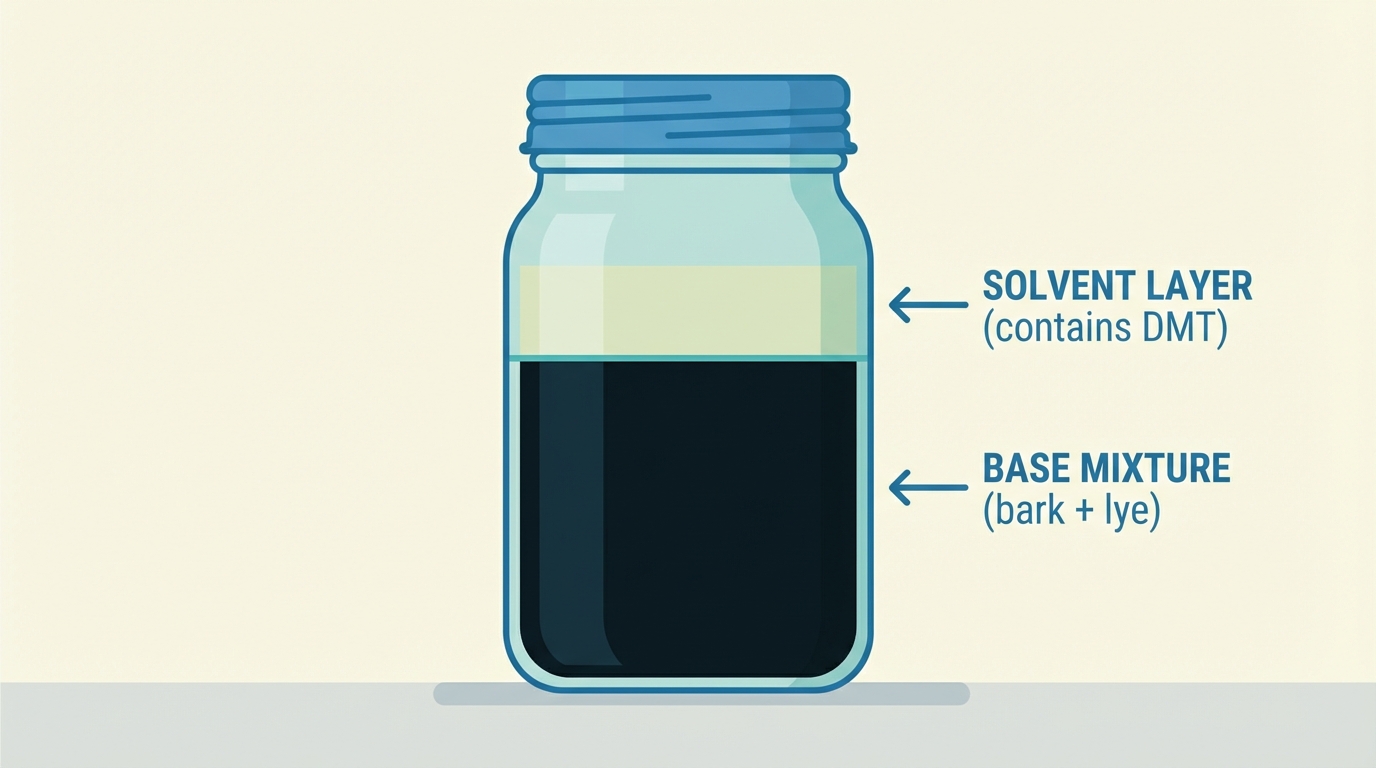 Two clean layers: the clear solvent on top now contains dissolved DMT. The dark base mixture sits below.
-
Let it sit for 5–10 minutes until the layers separate cleanly.
-
Repeat the invert-and-rest cycle about 8 times. Each round pulls more DMT into the solvent. This step takes about 1–2 hours total.
After 8+ rounds of mixing and separating, the solvent layer is now loaded with DMT.
Step 5: Transfer the solvent to the freezer dish
You now need to move the DMT-loaded solvent from the extraction vessel into your flat glass dish (the one that goes in the freezer).
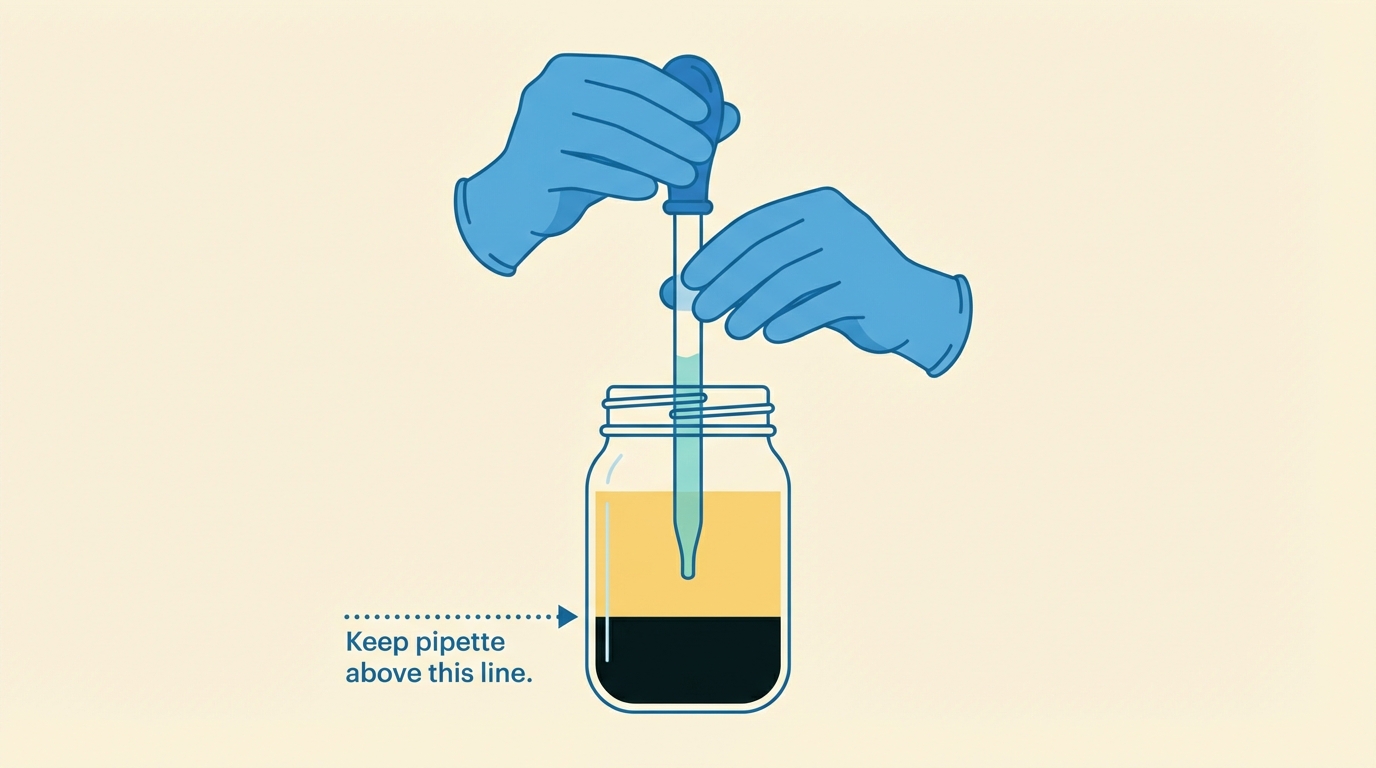 Carefully pipette the solvent layer. Take your time. It's better to leave a little solvent behind than to suck up base liquid.
How to use a pipette: Squeeze the bulb at the top, dip the tip into the clear solvent layer (keeping well above the dark bottom layer), and slowly release the bulb to draw up the liquid. Work in several small batches rather than trying to get it all at once.
-
Pipette the top solvent layer from the base mixture into the flat glass dish. Be careful not to suck up any of the dark base liquid. It's better to leave a little solvent behind than to contaminate your pull.
If you do accidentally pipette some lye, don't panic. Just do the optional water wash described below: it'll pull the lye back out of the solvent and you can carry on as normal.
Optional: water wash (for a cleaner product, or if you accidentally pipetted some lye)
If your final crystals end up with a lot of sticky yellow residue, you can add a water wash to this step in future extractions.
The wash removes plant impurities from the solvent. Instead of pipetting directly into the freezer dish, you pipette through a water bath first:
- Fill a glass or beaker with lukewarm water.
- Pipette the solvent into the water instead of into the dish. Stick the pipette tip near the bottom of the water and squeeze it out.
- The water may turn slightly yellow or dark as impurities or lye residues dissolve into it. This is the whole point of the wash.
- Now pipette the solvent back out of the water into your flat glass dish. Be careful not to suck up water.
Step 6: Freeze to form crystals
-
Close the lid and check that it seals.
-
Place the glass dish in the freezer.
-
Leave it for 24 hours. A regular kitchen freezer (around -18°C / 0°F) is perfect. The DMT crystallizes best when the dish is left still and undisturbed. Having larger crystals will make it easier to separate them from the solvent.
-
After 24 hours, take the dish out and uncover it. You should see white or yellowish crystals on the bottom of the dish.
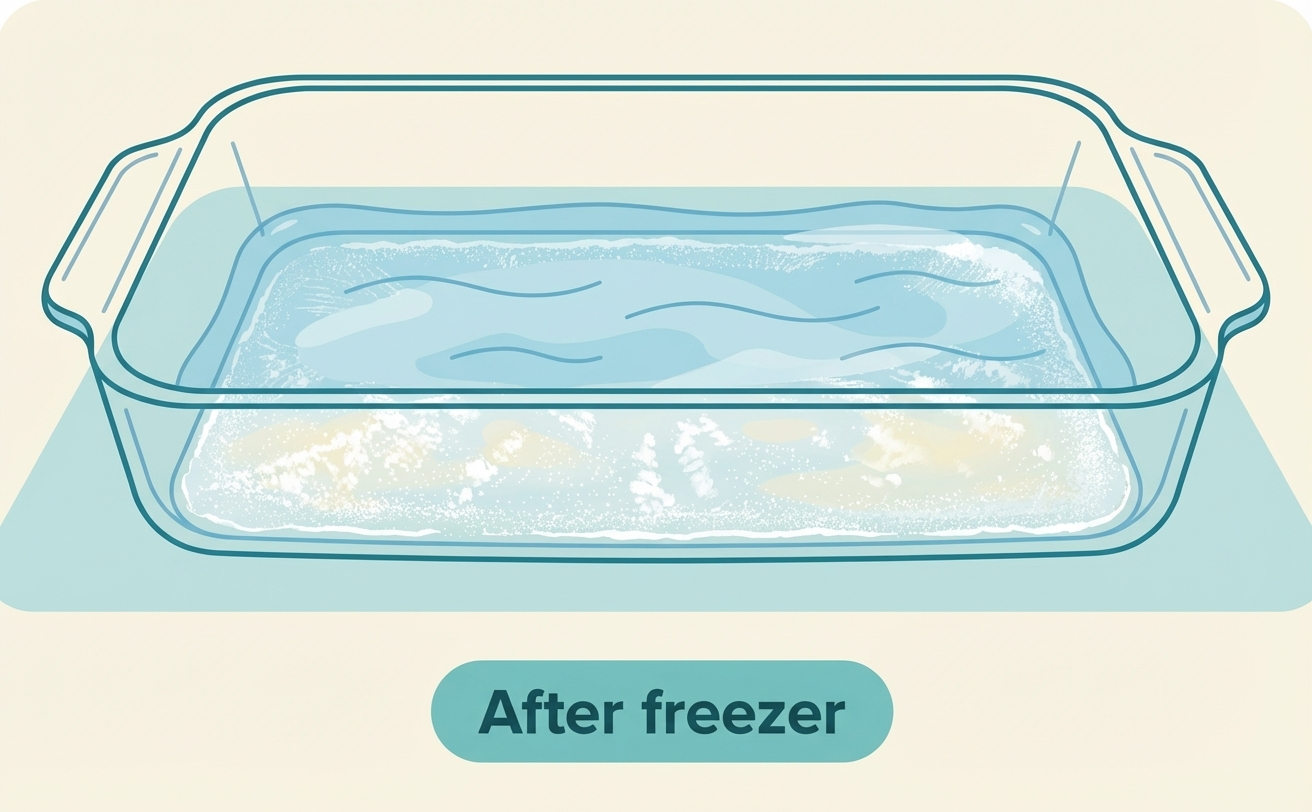 DMT crystals after freeze precipitation. The yield from a single pull.
Step 7: Dry the crystals and collect them
-
Carefully pour off the remaining liquid solvent. Tilt the dish slowly. The crystals will have settled at the bottom and most will stay in place. Pour slowly and steadily. Save the poured-off solvent for reuse in later pulls.
-
Let the dish sit for the remainder of the solvent to evaporate. To speed up the process, you can use a fan on a low setting, just enough to get the air to circulate. Avoid strong airflows, as they could blow small crystals away. Avoid heat, as it could melt some of the DMT.
-
Allow at least 3 hours for drying, though overnight is ideal to ensure all solvent has fully evaporated. The crystals are ready when they look dry and powdery, with no visible wet spots or solvent smell.
-
Scrape crystals off of the dish. The white crystals are DMT freebase. Scrape them off using a small blade, such as a razor blade. For storage, see section below.
- There will likely be a sticky yellow layer at the bottom and on the sides of the dish. These are oils and fats from the bark. Avoid collecting them together with the DMT, as they will cause problems in the vape. Aim at getting the white crystals without the sticky yellow layer.
-
Verify your product. Properly dried DMT crystals should have no solvent smell. If you want to confirm that what you have is actually DMT, you can use a reagent test kit such as Bunk Police's DMT Spot Kit.
(Optional) Step 8: Repeat (2nd, 3rd, 4th pulls)
One round of solvent extraction doesn't get all the DMT out of the bark. To maximize your yield:
- Add 120 ml of fresh solvent to the base mixture (which is still sitting in your vessel from Step 3).
- Repeat Steps 4–7: invert and separate, optionally wash, freeze, and dry.
- Consider doing at least two extra pulls, to maximize the yield.
Typical total yield from 125 g MHRB: roughly 0.5–1.5 g of DMT, depending on bark quality. This is enough for many aborting attempts. More than enough to get you started.
Storage and cleanup
Storing your DMT powder
Store the finished powder in a small airtight glass container (like a jar with a screw-on lid) in a cool, dark place. A freezer is ideal. DMT slowly degrades when exposed to air and light, but stored properly it keeps for months to years.
Some people prefer to prepare spare cartridges ahead of time and keep them in the freezer, ready for later use.
Storing leftover solvent
Leftover solvent (poured off after freezing) can be saved in a sealed glass bottle and reused for future extractions. Label it clearly and store it in a cool, well-ventilated place away from any heat sources. Solvent can be reused several times before it becomes too contaminated to work well.
Disposing of the base mixture
After your last pull, you'll have a vessel of dark, caustic lye-and-bark sludge. To dispose of it safely:
- Safety first. Wear gloves and goggles.
- Slowly add vinegar to the mixture while stirring. The vinegar (an acid) neutralizes the lye (a base). The reaction generates some heat, so add slowly.
- Test with a pH strip. Keep adding vinegar and testing until the pH reads between 6 and 8 (neutral).
- Strain out the bark material. The bark material can go in household waste.
- The remaining liquid is now safe to pour down the drain with plenty of running water.
Disposing of solvent you don't want to keep
Don't pour solvent down the drain. Instead, pour it into a shallow dish outdoors (or near an open window) and let it evaporate completely. Remember: no open flames while it's evaporating.
What's next
You now have DMT freebase powder. Head to Preparing Your DMT Vape Pen to dissolve it into vape liquid and load your pen.
Quick reference card
Save a screenshot of this section for quick access.
Shopping list
| Item | Key detail |
|---|---|
| MHRB | 125 g, powdered or shredded |
| Sodium hydroxide (NaOH) | 110 g, 99%+ pure, no additives |
| Solvent | 120 ml per pull. N-heptane or another non-polar solvent. |
| Salt | 30 g |
| Heat-resistant glass vessel (narrow opening) | For lye preparation |
| Second glass vessel (sealable) | For extraction, needs lid/stopper |
| Glass pipette | For transferring solvent |
| Flat glass dish with sealing lid | For freezer. Pyrex or similar |
| Kitchen scale + measuring cup | For measuring grams and ml |
| Gloves + splash goggles | For handling lye |
| Vinegar | For cleaning lye off surfaces (water only for skin!) |
| pH test strips | For verifying neutralization during cleanup |
Steps (1 day total, ~2–3 hours active)
- Crush 125 g MHRB to coffee-ground size
- Dissolve 110 g NaOH in 750–800 ml cold water (one tablespoon at a time!), add 30 g salt, cool to room temp (2–4 hrs)
- Combine: add bark to lye in sealable vessel, stir 2 min, rest 10 min, stir 2 min, rest 10 min
- Extract: add 120 ml solvent, seal, invert ~10 times (gentle shake OK), rest 5–10 min, repeat 8+ times (1–2 hrs)
- Transfer: pipette solvent into freezer dish (optional: wash through warm water first for cleaner product)
- Freeze: seal dish, freeze 24 hours undisturbed
- Dry crystals with airflow, ~3 hours, no open flames
- Repeat steps 4–7 at least 2 more times with fresh solvent
- Clean up: neutralize base with vinegar (test pH 6-8 with strips), strain bark, pour liquid down drain; evaporate solvent outdoors or save for later
Did this guide teach you something you'll act on?
Disclaimer
The information on this website is provided for educational and harm reduction purposes only. It does not constitute medical advice and should not replace consultation with a qualified healthcare professional. See our Legal page for more details.