Cluster headache vs migraine: how to tell the difference
Cluster headache attacks are shorter, more frequent and more painful than migraines. Learn the key differences and how to rule out similar conditions.

Written by Nicolas Macé, PhD
Cluster headaches and migraines differ in duration and frequency, and have different pain characteristics:
- Duration: untreated, cluster headache attacks last 15 minutes to 3 hours, while migraine attacks last 4 to 72 hours.
- Intensity and pain quality: cluster headache pain is stabbing, like a red-hot poker in the eye. Untreated, the pain is severe to excruciating: often the worst pain you have ever experienced. Migraine pain is usually throbbing, and moderate to severe.
- Frequency: during a cluster headache bout, attacks occur most days, and often several times a day. Migraine attacks are less frequent: rarely more than a couple attacks per month.
Do you suspect you have cluster headaches?
Take the two-minute testGetting the diagnosis right matters because the treatments differ. Many migraine treatments, including painkillers (ibuprofen, paracetamol) do not help with cluster headaches. Conversely, while high-flow oxygen is a first-line treatment for cluster headache attacks, it's not an established migraine treatment. Read our guides to learn about the most effective cluster headache treatments.
The rest of this guide breaks down how cluster headache differs from migraine, and from other conditions it is often confused with: tension headaches, nose and teeth problems, trigeminal neuralgia, and rarer conditions that can be confused with cluster headache.
Key differences between cluster headache and migraine
In short: Cluster headache attacks are shorter (15 minutes to 3 hours vs 4 to 72 hours), far more frequent (up to several per day during a bout vs a few per month), and much more intense than migraine attacks. Cluster headache pain is usually stabbing rather than throbbing, and causes severe restlessness rather than making you want to lie still.[1] In one screening study, 69% of cluster headache patients chose "a red-hot poker in the eye" to describe their attacks, against 16% of migraine patients.[2]
| Feature | Cluster headache | Migraine |
|---|---|---|
| Duration (untreated) | 15 minutes to 3 hours | 4 to 72 hours |
| Pain intensity | Severe to excruciating; often described as the "worst pain ever experienced." May cause suicidal ideation. | Moderate to severe. |
| Pain quality | Stabbing, like a red-hot poker in the eye | Usually throbbing |
| Frequency | Very frequent during a cluster period; typically occurs at least every other day, and often multiple times per day | Less frequent: typically one attack per month, very rarely more than 10 per month |
| Pain response | Causes severe restlessness: you will pace or even bash your head against objects. | Worsened by physical activity: you will typically want to stay still in a quiet, dark room. |
| Treatments | Responsive to high-flow oxygen; standard painkillers (ibuprofen, paracetamol) and opioids are ineffective. | Standard painkillers often (but not always) bring relief. No evidence of oxygen effectiveness. |
| Timing | Attacks often occur at the same time(s) of day and re-occur during specific seasons. | Irregular timing. |
| Autonomic signs: on the painful side, a red or watery eye, a runny or blocked nose, or a drooping or swollen eyelid | Autonomic signs are strong evidence of cluster headaches. | Autonomic signs are possible, but not common. |
Cluster periods are the weeks or months during which attacks occur regularly. Chronic cluster headache sufferers, however, get attacks all year long.
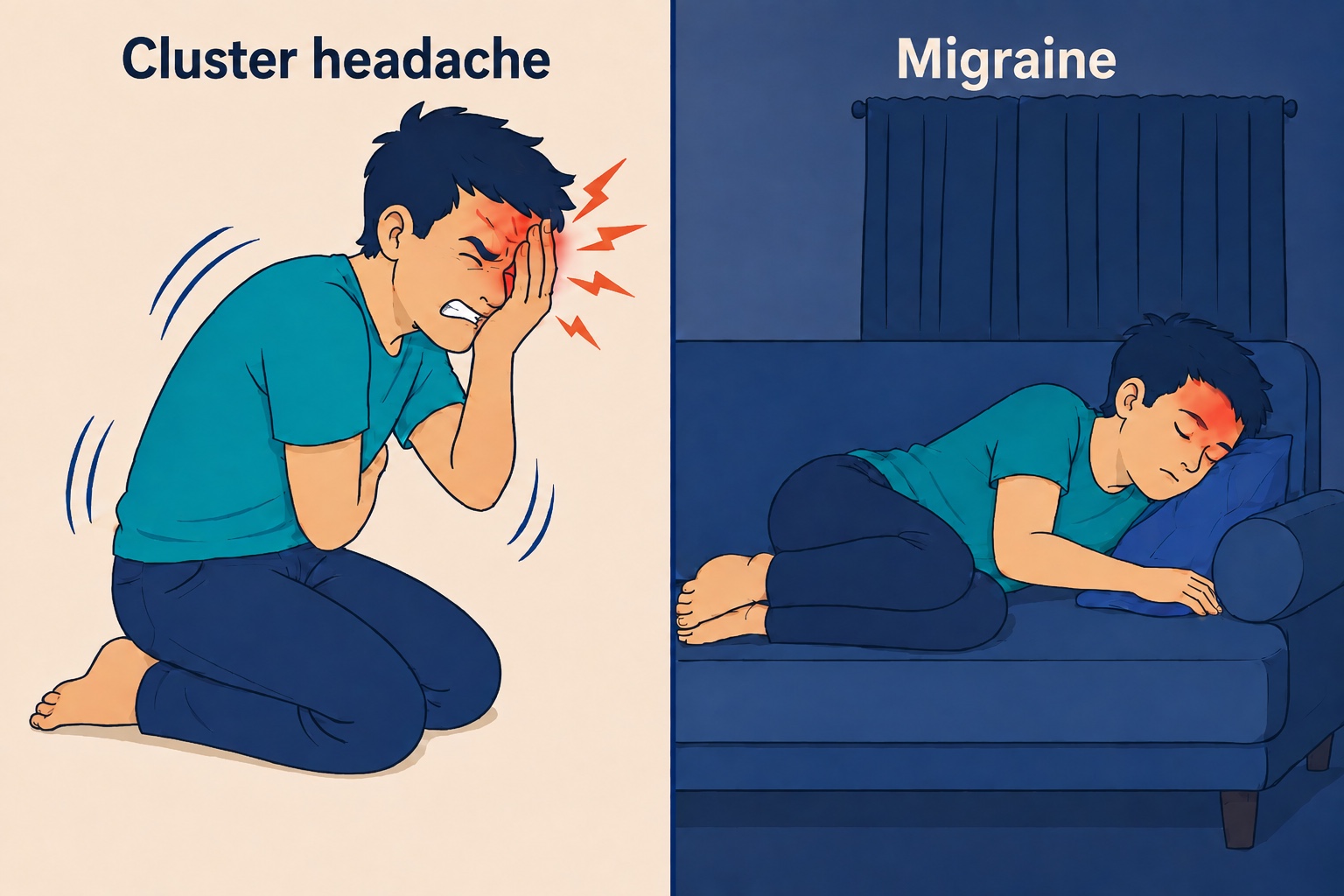
The intense cluster headache pain makes you restless (left), whereas movement tends to worsen a migraine, and so you will want to stay still (right).
Key differences with other conditions
Cluster headaches are typically differentiated from similar-looking conditions by their duration and the presence of autonomic signs, as illustrated below.
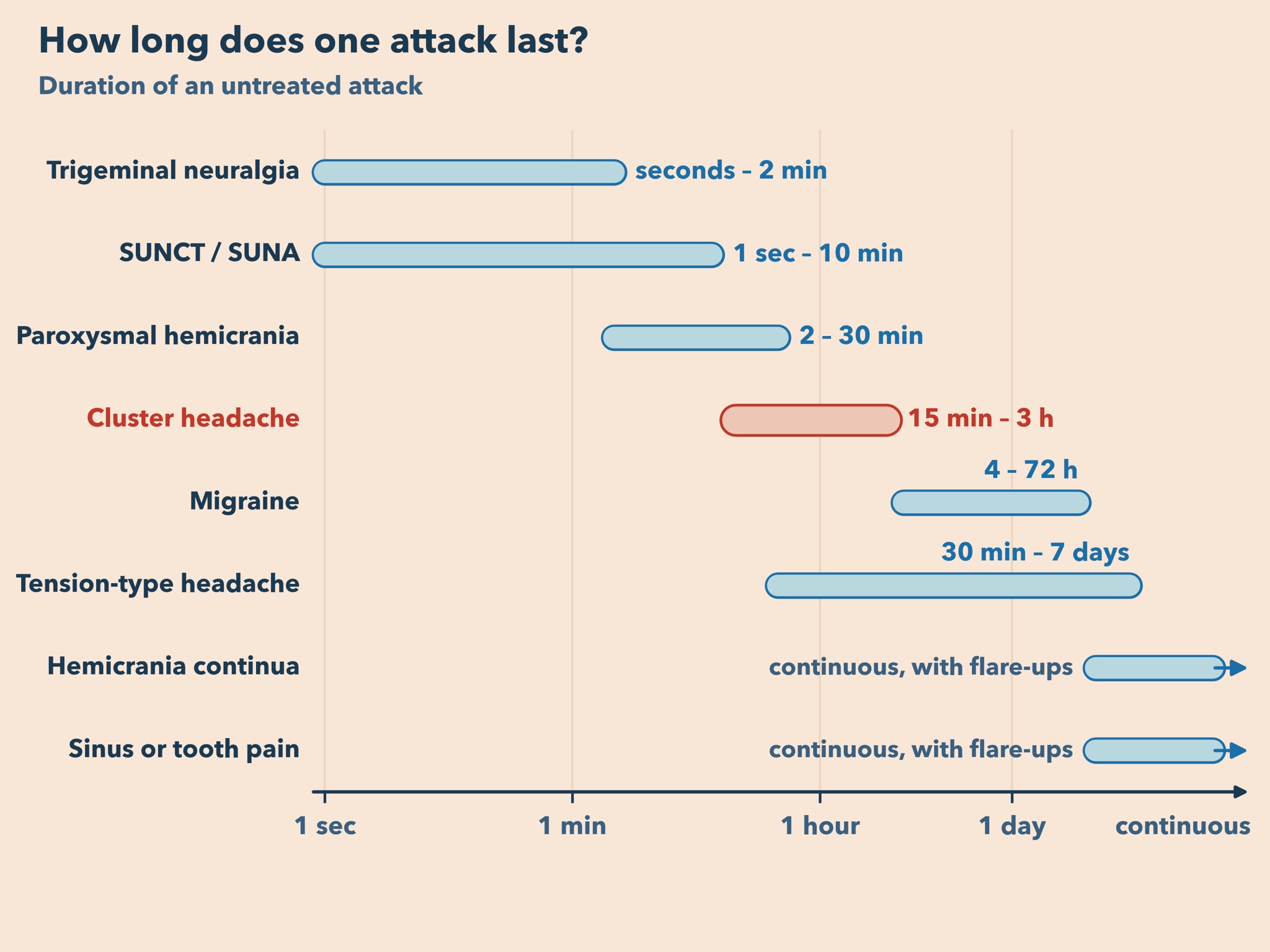
Cluster headache attacks typically last from 15 minutes to 3 hours. This separates them from migraines, and from other conditions discussed below.
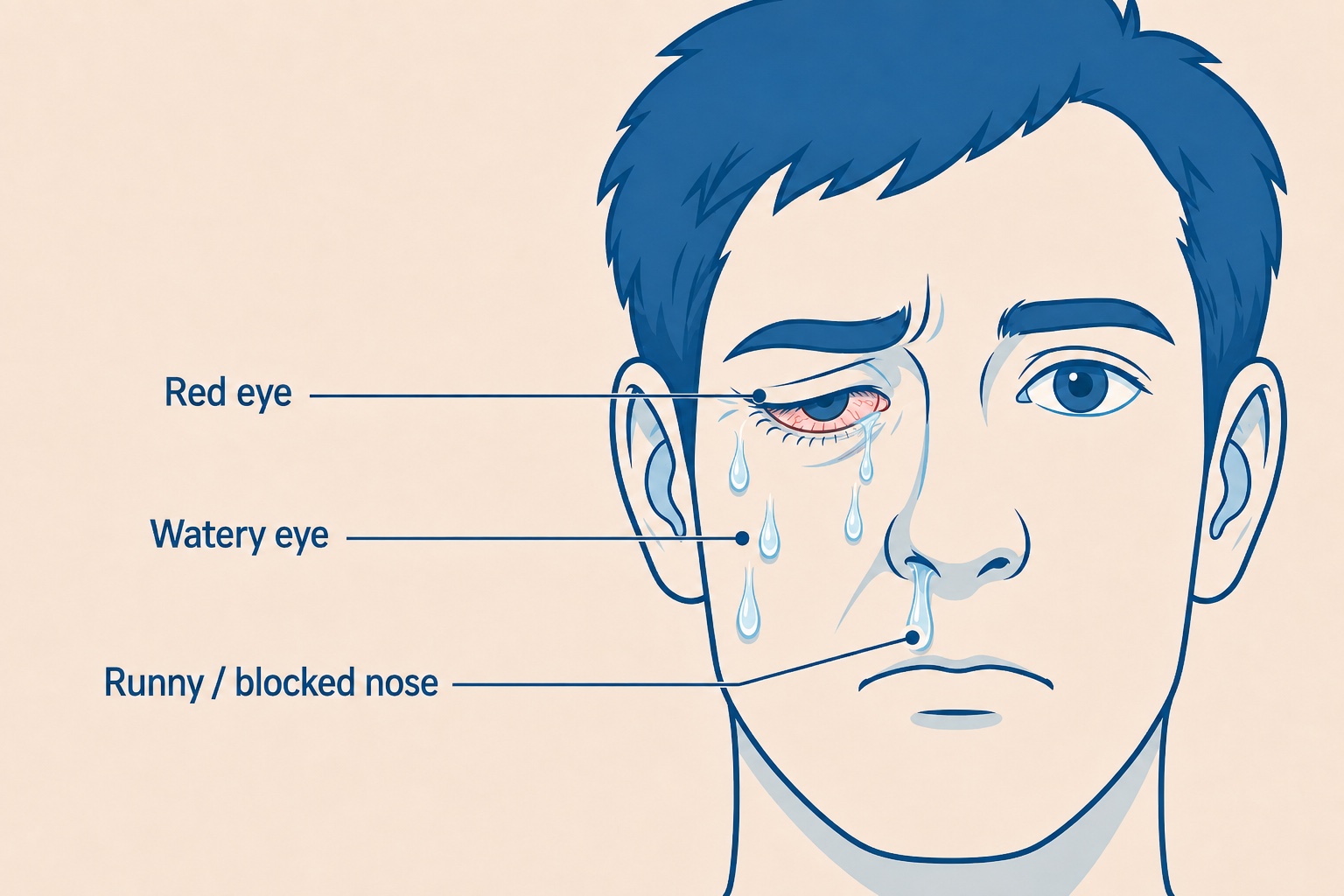
The presence of one of the following autonomic signs on the painful side is indicative of cluster headache: a red or watery eye, a runny or blocked nose, a drooping or swollen eyelid, a smaller pupil, or sweating on the forehead or face.
Tension headaches
Tension headaches (or tension-type headaches) are very common. Therefore, many people who suspect they have cluster headaches will actually suffer from tension headaches. The main difference is pain intensity: tension headache pain is typically mild or moderate, while cluster headache pain is severe or excruciating.
If your attacks have the following characteristics:
- Severe or excruciating pain
- Localized on one side of the head (behind the eye)
- Sharp pain rather than feeling like your head is tightened or under pressure
then you likely don't suffer from tension headaches, and you might have cluster headaches. Take our 2-minute test.
Nose- or teeth-related pain
Cluster headache is often mistaken for a nose or teeth problem, since attacks can cause a blocked or runny nose on the painful side, and since the pain can radiate into the upper teeth. The main differences are:
- Duration: Cluster attacks last 15 minutes to 3 hours and then stop completely, while nose or teeth pain is continuous over days (with occasional flare-ups).
- Pain characteristics: Nose-related pain usually feels like a moderate pressure, while cluster headache pain is stabbing and much more intense. Teeth-related pain is centered on teeth and often worsens with chewing or hot/cold.
Trigeminal neuralgia
Trigeminal neuralgia causes brief jolts of one-sided facial pain, which feel like electric shocks. Like cluster headaches, the pain is intense and always one-sided, which is why they can get confused. The main differences are:
- Duration: trigeminal neuralgia jolts last from a fraction of a second to two minutes, while a cluster headache attack lasts 15 minutes to 3 hours.
- Build up: Trigeminal neuralgia jolts occur with no build up, while cluster headache pain builds up over minutes.
- Triggers: jolts can be caused by touching the face: even a breeze on the cheek can trigger one. Cluster headache attacks are not triggered by touch.
- Autonomic symptoms: a red or watering eye, a runny or blocked nose, or a drooping eyelid on the painful side all point to cluster headache, and typically do not happen in trigeminal neuralgia.
Other trigeminal autonomic cephalalgias
Cluster headache belongs to the trigeminal autonomic cephalalgias (TACs) family of conditions, which also include paroxysmal hemicrania, hemicrania continua, SUNCT and SUNA. All of them cause one-sided pain with the same autonomic symptoms: a red or watering eye, a runny or blocked nostril, or a drooping eyelid on the painful side. Other TACs are thought to be rarer than cluster headaches. Some respond to a specific anti-inflammatory (indomethacin), so they are worth ruling out with a neurologist.
| Condition | Pain intensity | Attack duration | Responsive to indomethacin |
|---|---|---|---|
| Cluster headache | Severe or excruciating | 15 minutes to 3 hours | No |
| Paroxysmal hemicrania | Severe | 2 to 30 minutes | Yes |
| Hemicrania continua | Continuous moderate pain, with flare-ups of moderate or greater intensity | Continuous pain for months, with hours- to days-long flare-ups | Yes |
| SUNCT / SUNA | Moderate or severe | From a second to 10 minutes, a succession of stabs of pain | No |
Paroxysmal hemicrania
The attacks look like mini cluster headache attacks: same one-sided pain around the eye or temple, same autonomic symptoms as cluster headaches, but shorter (2 to 30 minutes) and more frequent (usually more than 5 per day). Paroxysmal hemicrania is responsive to indomethacin.
Hemicrania continua
Hemicrania continua does not come in attacks. It is a continuous one-sided background pain, present for months, with flare-ups of more intense pain. Hemicrania continua is responsive to indomethacin.
SUNCT / SUNA
SUNCT and SUNA both cause one-sided pain attacks lasting from a second to about 10 minutes. The pain comes in a succession of short stabs. It is usually associated with a teary red eye on the painful side.
SUNCT stands for short-lasting unilateral neuralgiform headache attacks with conjunctival injection and tearing.
SUNA stands for short-lasting unilateral neuralgiform headache attacks with cranial autonomic symptoms.
What is a "cluster migraine"?
There is no such thing as "cluster migraines". Cluster headache and migraine are two distinct, separate medical conditions, and "cluster migraine" is not a recognized medical term; it is simply a mix-up of the two names.
However, you can have both cluster headaches and migraines. As they are in general treated differently, speak to your doctor to understand your treatment options if you suffer from both.
References (2)
- ↩ Headache Classification Committee of the International Headache Society (IHS) (2018). The International Classification of Headache Disorders, 3rd edition. Cephalalgia, 38(1), 1–211. doi:10.1177/0333102417738202
- ↩ Buture A, Boland JW, Dikomitis L, Huang C, Ahmed F (2020). Development and evaluation of a screening tool to aid the diagnosis of a cluster headache. Brain Sciences, 10(2), 77. doi:10.3390/brainsci10020077
Did this guide teach you something you'll act on?
Disclaimer
The information on this website is provided for educational and harm reduction purposes only. It does not constitute medical advice and should not replace consultation with a qualified healthcare professional. See our Legal page for more details.